Community connections for older adults are not a lifestyle preference. They are a health necessity. The research on what social isolation does to the aging body and brain is consistent enough that the medical community now treats isolation as a clinical risk factor alongside smoking, obesity, and physical inactivity. What community living provides, in its most functional form, is a structural answer to that risk.
Most families start researching senior living when care needs become the main concern. Medications. Mobility. Safety. These are the right questions. But the quality of daily life in any senior living community, and the speed of cognitive and physical decline within it, is shaped as much by the quality of social connection as by the quality of clinical care.
Community connections for seniors are not a feature of senior living. They are one of the primary mechanisms through which senior living works.
Key Takeaways
- The National Institute on Aging identifies social isolation and loneliness as serious health risks for older adults, linked to higher rates of cognitive decline, depression, heart disease, and premature mortality.
- A 2025 U.S. News survey found that among seniors who reported loneliness and isolation before their move to senior living, assisted living consistently helped them maintain or improve health and find enjoyment and meaning in daily life.
- Community connections support healthy aging across physical, cognitive, and emotional dimensions simultaneously, making them one of the highest-leverage interventions available in senior care.
- Older adults in communities with active social programming, external partnerships, and consistent peer interaction show measurably different health trajectories than those in isolated home-based care settings.
- At Park Visalia in Visalia, California, community connections extend beyond in-house programming to recurring partnerships with local organizations, performers, and civic groups that bring the broader Visalia community into residents’ daily lives.
What Community Connection Actually Means for Older Adults
Community connection for older adults means more than having people nearby. It means feeling genuinely known, part of a group that notices when you are absent, shares experiences with you regularly, and provides both the stimulus of social engagement and the comfort of a consistent familiar presence.
This is a distinction that matters clinically. Research on social connection and aging distinguishes between the mere presence of other people, which can exist in institutional settings without producing meaningful social benefit, and genuine relational connection, which requires reciprocity, familiarity, and shared experience over time. Senior living communities that build structured, consistent opportunities for residents to form real relationships provide something categorically different from housing that simply places people in proximity.
For families evaluating senior living options, the practical question is not whether a community has social activities but whether the daily structure produces the kind of ongoing connection that builds into a close relationship over weeks and months. Our sister community Castro Valley has an article on why social activities in assisted living change everything for seniors, covering the research on what consistent social engagement produces over the course of a year. Note that specific programming described there reflects Castro Valley and may differ here.
Why Isolation Is the Specific Health Risk That Community Connections Counter
Social isolation in older adults is not a quality-of-life issue. It is a clinical one, and the evidence for treating it as such has become specific enough that ignoring it in any comprehensive care model is a significant oversight.
The National Institute on Aging identifies social isolation and loneliness as serious health risks for older adults, linked to higher rates of cognitive decline, depression, heart disease, and premature mortality. Older adults who are socially isolated have a 50 percent higher risk of developing dementia. They experience higher rates of anxiety and depression. They are more likely to have difficulty managing chronic health conditions that otherwise respond well to treatment.
The mechanism is not simply psychological. Chronic loneliness activates stress responses at the physiological level, elevating cortisol and inflammatory markers, suppressing immune function, and disrupting sleep. These are the same physiological pathways that chronic illness and chronic stress activate. The body, at the biological level, does not clearly distinguish between the distress of social isolation and the distress of physical threat.
Community connections for seniors counter this mechanism directly and structurally. They provide the consistent peer interaction, shared daily experience, and sense of belonging that keep those stress pathways from activating chronically.
How Community Connections Support Physical and Cognitive Health in Seniors
The benefits of community connections for older adults are measurable across physical, cognitive, and emotional health simultaneously, which is what makes them disproportionately valuable in senior care settings.
Physical Health
Seniors who maintain active social lives are more likely to remain physically healthy. Social connection in senior living creates built-in motivation for physical activity: a fitness class is more likely to be attended when a friend expects you there. A walk outside is more likely to happen when someone is waiting on the path. Shared meals, group outings, and community events all involve movement that would not happen in isolation at home. The physical benefits of social connection are not incidental to the social activity. They are produced by it.
Cognitive Health
Social engagement stimulates cognitive function in ways that solitary activity does not. Conversation requires attention, working memory, language production, and the real-time processing of another person’s responses — a form of cognitive exercise that card games, puzzles, and television cannot replicate. Research on aging consistently shows that socially engaged older adults show slower rates of cognitive decline than those who are isolated. For older adults with early-stage cognitive changes, maintaining strong social connections is one of the most reliably effective non-pharmacological interventions available.
The best thing a senior living community can do for a resident’s cognitive health is give them people to talk to every day about things that matter to them.
What Happens When Older Adults Feel a Sense of Belonging
A sense of belonging — the feeling of being genuinely part of a community where one’s presence matters, produces effects on well-being that are distinct from the effects of social activity alone. Belonging requires that the people around you know who you are, notice when something changes, and value your continued presence. This is what the research distinguishes as the deeper function of community connection in senior living.
Older adults who feel they belong to their community show greater resilience in the face of health challenges, greater willingness to ask for help, and greater reported life satisfaction across virtually every dimension studied. They are also more likely to sustain engagement with activities and programs over time, which compounds the cognitive and physical benefits of those activities.
For families evaluating senior living communities, belonging is visible in specific indicators: whether long-tenured staff know residents by name and personal history, whether residents know each other and have developed real friendships, and whether the community’s programming creates recurring shared experiences that build familiarity over time. Our article on what life is like in assisted living at Park Visalia covers what belonging looks and feels like in a community with established programming and long-tenured staff.
The Role Community Plays in Successful Aging
Successful aging (defined in gerontology as maintaining physical function, cognitive health, and engagement with life) is associated more strongly with social connection than with almost any other variable studied. This finding has been replicated across decades of research and multiple countries, and it holds across socioeconomic status, prior health history, and genetic predisposition.
The reason is straightforward: aging in isolation removes the daily inputs that sustain cognitive function, emotional regulation, and motivation for physical activity. A person living alone with declining mobility and shrinking social circles is losing those inputs one by one. A person living in a community with daily shared meals, consistent peer interaction, and programming that connects them to the broader world outside the building is receiving those inputs consistently, whether or not they are conscious of seeking them.
For families who are weighing the timing of a move to senior living, this research carries a specific practical implication. The benefits of community connection for seniors are cumulative. They build over time. A person who moves to a senior living community while still cognitively present and physically active accrues those benefits from a position of strength. A person who moves after a crisis accrues them from a position of depletion. The difference in outcomes is documented and consistent. Our article on the benefits of moving to assisted living early covers what the research shows about adjustment outcomes at different stages.
What Community Connection Looks Like at Park Visalia in Visalia, CA
Park Visalia offers assisted living and memory care in Visalia, California, in a community where connection is built into the daily structure — not offered as an optional add-on.
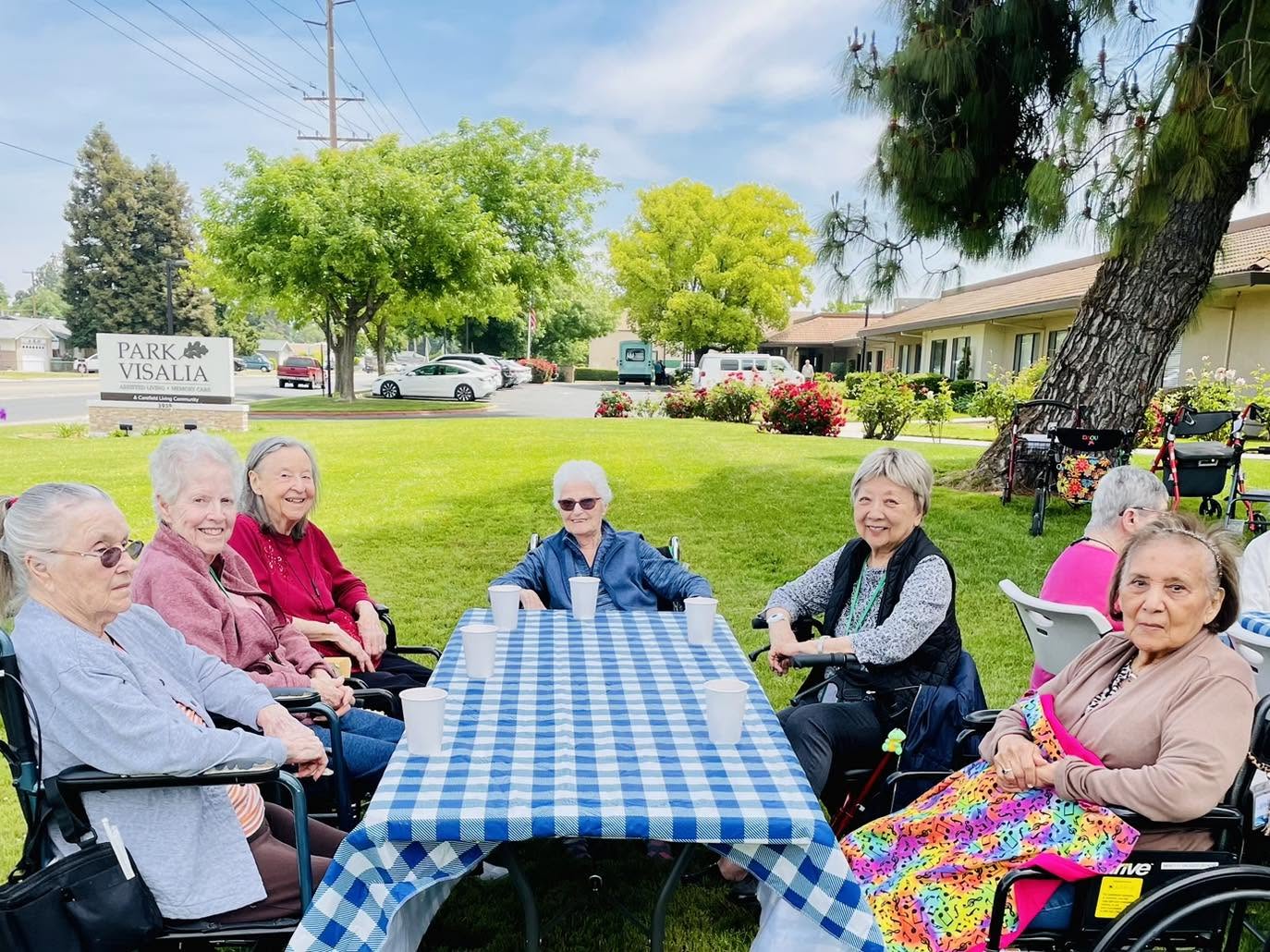
Daily programming creates a consistent shared experience that builds into genuine friendship over time. Partnerships with Bristol Hospice, Gentiva, Senior Helpers Visalia-Tulare, and local performers bring the wider Visalia community into residents’ daily lives on a recurring basis. The private park, wheelchair-accessible garden beds, shared mealtimes, and event calendar all create the conditions for the kind of regular, meaningful interaction that the research identifies as protective.
Visalia’s Central Valley community identity, its veteran presence, its local organizations, and its culture are all part of what residents at Park Visalia remain connected to. The community is not separate from Visalia. It is part of it.
Our article on community connections at Park Visalia covers the specific community partnerships and events that make this concrete in the daily life of residents here.
Choosing professional care for a loved one when home caregiving has reached its limits is a responsible decision, not a failure. The research on what community connections do for aging adults is clear: the benefits are real, cumulative, and not replicable in isolation. Families who make this decision while their loved one can still walk into a room and start a friendship, rather than after a crisis has made everything harder, give them a different start. The team at Park Visalia is here to answer questions at whatever pace feels right. This is not a commitment. It is a conversation.
Frequently Asked Questions
1. What are the benefits of community connections for older adults?
Community connections for older adults produce benefits across physical, cognitive, and emotional health simultaneously. Socially engaged older adults show slower rates of cognitive decline, lower rates of depression and anxiety, stronger immune function, and greater resilience in the face of health challenges.
2. Why is it important for seniors to socialize?
Socialization for seniors provides the cognitive stimulation, emotional regulation, and physical motivation that solitary living gradually removes. Conversation engages working memory, attention, and language in ways that passive activities cannot replicate. Shared activities create motivation for movement that would not exist in isolation. A sense of belonging to a community of people who notice your presence and value your continued participation supports emotional resilience in ways that clinical care alone cannot. Socialization is not supplementary to senior health. It is central to it.
3. What is the role of community in successful aging?
Research in gerontology consistently identifies social connection as one of the strongest predictors of successful aging, defined as maintaining physical function, cognitive health, and engagement with life over time. Older adults who belong to active social communities show markedly different health trajectories than those who are isolated, across multiple countries, socioeconomic backgrounds, and health histories. Community provides the daily inputs of shared experience, cognitive stimulation, and emotional belonging that aging in isolation progressively removes.
4. What are the benefits of social connection for older adults specifically?
Social connection for older adults lowers the risk of dementia by as much as 50 percent in some studies. It reduces rates of depression and anxiety, supports immune function, lowers chronic stress markers, improves sleep quality, and increases the likelihood of maintaining physical activity. It also produces the sense of purpose and belonging that research identifies as a predictor of longevity independent of physical health status. These benefits are cumulative: they build over time through consistent, ongoing connection rather than occasional social events.
5. Why is community important for older adults in senior living?
Community in senior living determines whether daily life produces the health benefits that social connection is known to provide or whether it simply places people in proximity without generating genuine relationships. The difference lies in whether the community’s structure, programming, and partnerships create conditions for consistent, recurring, meaningful interaction over time. Senior living communities that build those conditions — through shared mealtimes, consistent programming, long-tenured staff who know residents individually, and connections to the broader city around them — produce measurably different outcomes than those that do not.
6. What are the benefits of living in a community for seniors?
The benefits of community living for seniors include protection against social isolation, daily peer interaction that supports cognitive function, shared programming that motivates physical activity, a sense of belonging that supports emotional resilience, and access to external community connections that maintain residents’ engagement with the world beyond the building. Beyond these individual benefits, community living provides the safety and oversight that allows family members to be present as family rather than as caregivers managing every dimension of a complicated daily situation. That shift in the family relationship is one of the most consistent things families describe after making the transition to senior living.