

Reminiscence therapy activity are usually described as something that happens indoors: a photo album opened at a table, a playlist queued up for the afternoon, a scent-based memory box passed from hand to hand. All of it works. All of it brings a piece of the past into the room on purpose.
Most guides stop there. What they rarely picture is what happens when the room is not the destination.
A shelf of vintage kitchenware nobody arranged in advance. A display case of tools from a hundred years ago. A corner of a shop that smells like nothing in particular, until it smells like the exact right thing to the exact right person.
Reminiscence therapy does not stop working once someone walks out the front door. If anything, it gets harder to predict, and that is part of what makes it work.
What Most Guides Miss About Reminiscence Activities
Reminiscence therapy uses specific sensory and object triggers to unlock long-term memory, the kind that stays reachable in dementia even after short-term recall has faded. A photo does this. A song does this. A familiar smell does this. An outing does the exact same thing, just without anyone choosing the triggers in advance.
That is the part most activity guides leave out. They will tell you to build a memory box or a themed playlist, and they are right to do so. They rarely mention that a shop full of antique objects can do the same work, often better, because nobody has to guess which object might matter.
The Alzheimer’s Association notes that familiar objects and places can bring back older memories just as effectively as photos or music, and that even small, unplanned moments create real connection. An outing like the one Park Visalia recently took to a local antique shop works the same way: nobody chose the triggers in advance, and that is exactly what let one surface on its own.
A Trip to a Visalia Antique Shop
Lifestyle Director Rachel took a group of residents from Park Visalia to a local antique shop. Nobody went looking for a memory. They went looking for a nice afternoon, the kind of outing that gets residents out of the building and into the wider town they already know.
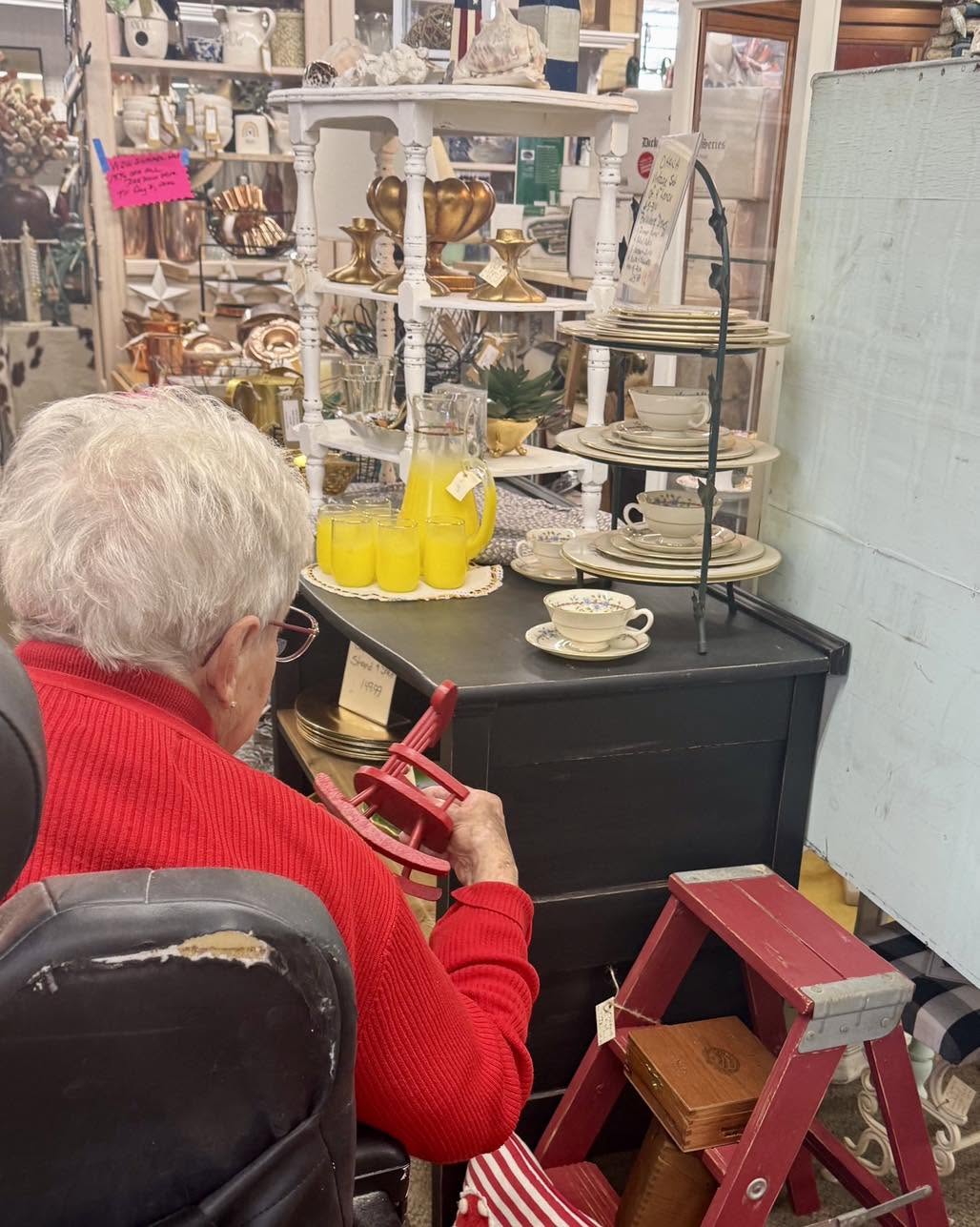
One resident’s attention caught on something specific among the shelves. Nobody had planned for that particular object to be there. Nobody could have staged it as well as the shop already had, decades of ordinary things sitting exactly where someone happened to notice them. What followed was a real memory, offered without being asked, and a conversation that had the same warmth reminiscence work is supposed to produce.
Nobody was running a session. They were just browsing.
That is the case for an antique shop over an activity table: the shop was not built for this, and that is exactly why it worked.
Why a Real Environment Beats a Curated One
A curated reminiscence activity depends on staff guessing correctly. Choose the right photo, the right song, the right object, and something might surface. Choose wrong, and the moment passes without anyone noticing what almost happened.
An outing removes the guessing. A shop, a market, a museum case, these are already full of objects spanning decades, more than any single activity table could hold. The odds of something unplanned and personal surfacing go up, not because staff got better at predicting memory, but because they stopped trying to.
Outings add something else, too. Walking through a shop, standing at a display case, moving from room to room, all of it is movement that a seated activity cannot offer. For residents who spend most of the week inside familiar rooms, a change of scenery does real work on its own, before a single memory is even triggered.
Our article on gardening therapy in senior living covers a related idea: how a wheelchair-accessible garden at Park Visalia turns a hands-on activity into something every resident can actually reach, not just observe.
What to Look for in a Good Reminiscence Outing
Not every destination works the same way. A few things are worth paying attention to, whether it is a family outing or a community-planned one.
Choose places dense with real, specific objects. Antique shops, flea markets, and small local museums tend to work because they hold more unplanned detail than any single planned activity can.
Keep the pace unhurried. A reminiscence moment tends to surface only when nobody is rushing toward the next stop.
Follow the resident’s attention, not a script. If something specific catches someone’s eye, the goal is to slow down and ask, rather than keep moving along a planned route.
Bring enough support to make the outing safe, not just possible. A good outing still needs staff or family who can manage mobility and keep an unfamiliar space from becoming disorienting.
What This Means Alongside a Community’s Daily Programming
Our sister community, Ojai Meadows, has a full guide to reminiscence therapy, covering the six recognized types of reminiscence and how to use all five senses during a visit. Read that guide for the indoor version of this work. Read this one for what happens when the work leaves the building.
A community that only offers reminiscence therapy indoors is offering half of what actually works. A resident who spends an afternoon at an antique shop has something to tell their family that a photo album alone would not have given them, a story that surprised even the person telling it. An unplanned story like that is worth as much as anything on a planned activity calendar. The team at Park Visalia is glad to talk through the range of outings residents take throughout the year, and what one could look like for your family.
Frequently Asked Questions
1. What are reminiscence activities?
Reminiscence activities are structured or informal experiences that use sensory and object triggers — photos, music, familiar scents, or physical places — to help older adults recall and share memories from earlier in their lives. They range from a conversation prompted by an old photograph to an outing that places residents inside an environment full of objects spanning decades, like an antique shop.
2. What is reminiscence therapy?
Reminiscence therapy uses meaningful memories, conversation, and sensory triggers to reduce depression, ease agitation, and improve quality of life in older adults, particularly those living with dementia. It works because long-term memory often remains accessible long after short-term memory has begun to fade.
3. What are some techniques used in reminiscence therapy?
Common techniques include photographs and memory boxes, personalized music playlists, familiar scents or foods, and guided storytelling prompts. A less common technique, and often an effective one, is the outing itself, taking residents somewhere full of real, unplanned detail rather than bringing a curated set of objects to them.
4. What are the benefits of reminiscence therapy?
Reminiscence therapy supports emotional well-being, eases isolation, and helps preserve a sense of identity, particularly for residents living with dementia. Outings add two things to the memory work: real movement and a genuine change of scenery, both of which matter on their own before any specific memory is even triggered.
5. What are some activities that encourage reminiscing?
Looking through old photographs, listening to music from someone’s youth, and cooking a familiar recipe all encourage reminiscing. So does an outing to a place dense with specific, tangible objects (an antique shop, flea market, small local museum). These outings can be more effective than a planned activity because the reminiscence is prompted by an authentic surprise rather than a staged prop.