
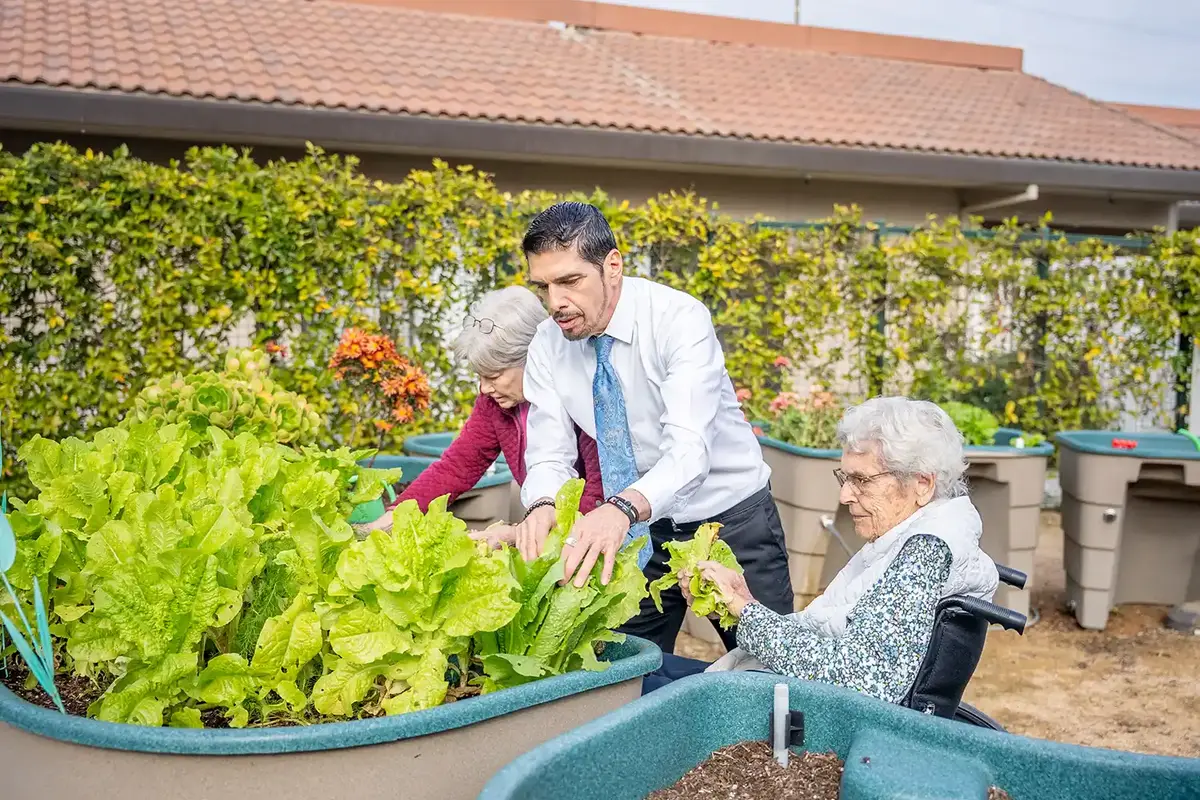
Gardening therapy in senior living uses plants, soil, and hands-on tending to improve attention, reduce agitation, lower stress, and restore a sense of purpose for older adults. Research shows benefits across physical, cognitive, and emotional wellbeing. At Park Visalia, wheelchair-accessible raised garden beds make gardening therapy available to every resident regardless of mobility.
On a Thursday morning, gardening therapy at Park Visalia looked like this: Chef Molly and the Lifestyle Team had taken residents to Home Depot to choose what they would plant. By the time they returned and moved to the raised beds, every resident who wanted to tend the garden could reach it — including those in wheelchairs. Seasonal herbs, vegetables, and went into the beds alongside the year-round succulents. Nobody was observing. Everyone who wanted to was participating.
Gardening therapy in senior living works, in large part, because it reconnects people to something familiar and purposeful. Decades of planting, tending, and harvesting belong to the histories of most older adults in ways that structured activities cannot touch. But that reconnection is only available to residents who can physically access the garden. That is where design becomes care.
Gardening therapy is not about producing a harvest. It is about having access to purposeful, sensory work that has always been part of daily life — and building the space so that access is not conditional on how well a resident can walk.
Key Takeaways
- A study published in Psychiatry Investigation via PMC found that horticultural therapy in senior living reduces agitation, improves attention, lessens stress, lowers as-needed medication use, and reduces falls. The study specifically notes that raised planters allow residents to use their hands and simple tools for active gardening participation with supervision.
- Gardening therapy is appropriate across multiple stages of dementia, with supervised therapeutic gardens and raised planters making active participation possible even for residents with significant cognitive changes.
- The difference between a decorative garden and a therapeutic one is whether the design enables participation or only observation. Wheelchair-accessible raised beds are one of the clearest expressions of that distinction.
- Park Visalia features wheelchair-accessible raised garden beds allowing every resident, including those who use wheelchairs, to plant, tend, and harvest. Seasonal herbs, vegetables, and fruit are planted throughout the year.
What Gardening Therapy in Senior Living Actually Does
Gardening therapy, also called horticultural therapy, produces measurable benefits across the physical, cognitive, emotional, and social dimensions of well-being in older adults — and the research supporting its use in senior living settings has been growing for decades. A review published in Psychiatry Investigation found preliminary evidence that horticultural therapy in assisted living and memory care reduces pain perception, improves attention, lessens stress, modulates agitation, lowers the use of as-needed medications and antipsychotics, and reduces falls in dementia unit residents.
The mechanisms behind these benefits are multiple. Physical contact with soil and plants stimulates sensory pathways that indoor environments cannot replicate. Natural settings engage involuntary attention, which rests and restores the voluntary attention that dementia progressively depletes. Sunlight in garden settings supports Vitamin D production and helps regulate circadian rhythms, affecting sleep quality and sundowning. And the purposefulness of tending something alive, planting a seed, watering an herb, watching a fruit develop, provides a sense of responsibility and accomplishment that most recreational activities do not.
The study also draws a specific conclusion about design: therapeutic gardens should include familiar elements from the region and activities that residents may have participated in at previous stages of their lives.
Why Wheelchair Accessibility Changes Who Participates in Garden Therapy
A garden that ambulatory residents can reach and wheelchair users can only observe is not a therapeutic garden for the full community. It is a garden for some residents and scenery for the rest. The distinction between these two outcomes lives entirely in the design of the garden bed.
| Therapeutic Garden Design | Decorative Garden Design |
| Wheelchair-accessible raised beds at usable height | Ground-level planting inaccessible to wheelchair users |
| Active participation for all mobility levels | Observation available to all, participation for some |
| Seasonal planting cycle connecting residents to time | Static plants requiring no resident interaction |
| Supervised hands-on activity with soil and tools | Landscaping maintained by staff only |
| Familiar plants connected to residents’ histories | Decorative plants selected for visual appeal |
The PMC study specifically notes that some therapeutic gardens include raised planters where residents can use their hands or simple safe tools for digging and other activities with supervision. That design detail determines whether a resident in a wheelchair is a participant or an onlooker. In a community where a significant portion of residents use wheelchairs, it determines how much of the community has access to the benefits of gardening therapy.
This is the argument behind the raised garden beds at Park Visalia. The decision to build wheelchair-accessible beds is not a design flourish. It is a position on who deserves to garden.
Our article on the benefits of moving to assisted living early covers how early transitions to senior living allow residents to engage with programming like this while their physical and cognitive capacity to participate is still strong.
What Gardening Provides That Most Other Activities Cannot
Gardening is one of the few activities in senior living programming that connects physical engagement, sensory stimulation, purposeful work, and personal history simultaneously — and it does so in a way that most structured activities cannot replicate.
The sensory dimension is particularly significant for residents with dementia. The smell of soil, the texture of a leaf, the weight of a watering can, the sight of something green in direct sunlight: these are stimuli that activate present-moment attention in ways that indoor activities often cannot. For a person whose verbal communication has become difficult, the garden provides engagement that does not require words.
The seasonal rhythm of a living garden also provides something a fixed activity calendar cannot: change that is natural, predictable, and meaningful. Residents at Park Visalia work with succulents that stay through every season and with herbs, vegetables, and fruit that cycle with the time of year. Planting something in summer that will be ready by fall is a small anchor in time that matters more for some residents than it might appear.
A Gardening Preparation at Park Visalia
This month’s trip to Home Depot did not start as a gardening activity. Park Visalia’s Executive and Culinary Director needed herbs for an upcoming community event, and residents came along for the errand. What began as a supply run turned into an outing, and by the time the group got back, it turned into something else again: an afternoon of planting.
That kind of organic shift is its own kind of therapy. Nobody scheduled a gardening session that day. Residents were included in an ordinary piece of community business, given a reason to be out and choosing alongside staff, and the planting that followed grew out of that inclusion rather than a program built around it.
By the time the group returned and moved to the garden beds, the residents who joined were not observing a demonstration. They were gardening. Hands in soil. Seasonal selections going into the beds alongside the succulents already in place. The wheelchair-accessible design meant participation was not determined by mobility.
That Thursday was not a scheduled gardening session. It became one anyway, and that is what the garden at Park Visalia makes possible: real inclusion that turns into real programming.
Our article on what life is like in assisted living at Park Visalia covers the full picture of what daily programming and community life looks like here throughout the year.
Gardening Therapy at Park Visalia in Visalia, CA
Carefield Park Visalia offers assisted living and memory care in Visalia, California, featuring wheelchair-accessible raised garden beds as part of the community’s outdoor programming. The beds are accessible to every resident, regardless of mobility level. Seasonal herbs, vegetables, and fruit are planted throughout the year alongside year-round succulents that give the garden continuity across every season.
Visalia’s Central Valley climate supports outdoor gardening across more of the year than most California locations north or west of the San Joaquin Valley. The mild winters and warm growing seasons mean the garden at Park Visalia is a year-round resource, not a seasonal amenity.
Park Visalia maintains community connections that extend the gardening program into the broader Visalia community. Our article on community connections in senior living at Park Visalia covers how those relationships shape daily life for residents throughout the year.
What families describe after moving a loved one to Park Visalia is often smaller than they expected but more consistent. A morning with soil on their hands, choosing what to plant, and watching it grow. Visit the following week, walking to the beds together to see what came up. That continuity is what good programming produces over time, and the garden at Park Visalia is part of it.
The team at Park Visalia is here to show you what daily life looks like, including a walk through the garden to see what’s growing.
Frequently Asked Questions
1. What is the meaning of gardening therapy?
Gardening therapy, also called horticultural therapy, is the intentional use of plants and gardening activities to address physical, cognitive, emotional, and social well-being in therapeutic and rehabilitation settings. In practice, it involves structured, supervised access to garden beds, planting activities, sensory engagement with plants and soil, and the rhythmic, purposeful act of tending something alive. Research has found benefits, including reduced agitation, improved attention, lessened stress, lower medication use, and reduced falls in senior living residents.
2. Is gardening good exercise for the elderly?
Yes. Gardening provides physical activity that engages fine motor skills, light strength, balance, and coordination. For seniors with limited mobility, wheelchair-accessible raised garden beds allow upper body engagement, fine motor practice, and the physical-sensory experience of handling soil, plants, and tools without requiring standing or walking.
3. In which stage of dementia is gardening appropriate?
Gardening can be appropriate across multiple stages of dementia with supervision and appropriate design. Research on therapeutic gardens in dementia care found benefits, including reduced agitation, improved mood, and lower medication use even in residents with moderate to severe dementia. The key factors are supervision, non-toxic plants, safe tools, and garden designs that avoid disorientation. Raised beds at wheelchair height make active participation possible even for residents with significant physical limitations alongside cognitive changes.
4. What are the techniques of garden therapy?
Garden therapy techniques include active planting and tending of raised beds, sensory gardening involving touch, smell, and visual engagement with plants, harvesting activities, and plant propagation. Raised planters at wheelchair height are among the most practical techniques because they enable participation regardless of mobility level. Sensory gardens incorporate fragrant herbs, textured plants, and seasonal color to engage attention. For residents with dementia, familiar plants connected to personal history are particularly effective because they connect to long-term memory and personal identity.
5. What plants are good for dementia gardens?
The most effective plants for dementia gardens are those personally meaningful to the residents who will tend them. Fragrant herbs such as rosemary, lavender, mint, and basil provide strong olfactory stimulation and are familiar to many older adults. Vegetables like tomatoes, zucchini, and peppers are approachable for residents with gardening histories. Seasonal fruit provides a sense of time and harvest. Year-round succulents give the garden continuity. All plants in therapeutic dementia gardens should be non-toxic, since some residents may handle or taste .