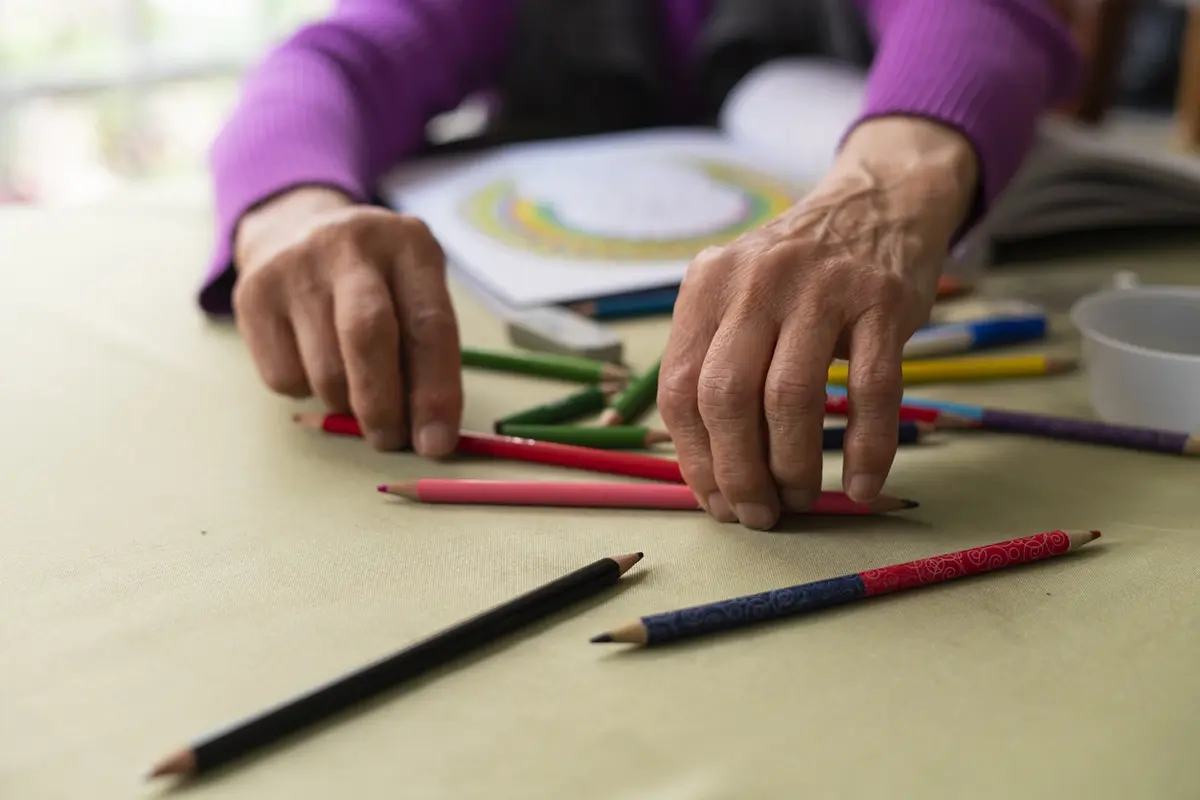
Sorting crayons is a structured volunteer activity at Carefield Pleasanton where memory care residents sort donated crayons by color twice a month for a nonprofit that recycles them into new crayons for children’s hospitals. What looks like a simple craft task is actually a purposeful activity that engages residents physically, emotionally, cognitively, and socially at once, the kind of role that research links to better outcomes than passive programming.
Most senior living activity calendars are built to fill hours. The best ones are built around something more specific: giving a resident a reason to get up that has nothing to do with the schedule and everything to do with who they still are.
That distinction is the whole idea behind Carefield Pleasanton’s Make a Difference Club, and sorting crayons is where it happens.
Key Takeaways
- Purposeful activities in memory care give residents a genuine role, not just a task, which research links to better emotional, cognitive, and social outcomes than passive programming.
- Carefield Pleasanton’s Make a Difference Club, formed in 2022, gives memory care residents a structured way to volunteer twice a month, sorting donated crayons for the nonprofit Crayon Initiative.
- Since 2022, residents have sorted roughly 600 pounds of crayons, producing about 24,000 new crayons and 3,000 boxes delivered to pediatric hospitals across the country.
- The activity engages residents physically, emotionally, cognitively, and socially at the same time, a combination most single-purpose activities cannot match.
- Many club members had careers as parents, educators, doctors, nurses, business owners, and engineers. The drive to contribute that shaped those careers does not disappear with a dementia diagnosis.
Why Purpose Does Not Disappear With a Dementia Diagnosis
People living with dementia retain the same basic need for purpose that they had before their diagnosis, even as other capacities change. That need does not get smaller because someone now lives in a memory care community. If anything, it becomes harder to meet.
Residents who spent decades as parents, professionals, and caregivers built identities around contributing to something bigger than themselves. Losing easy access to that role, whether through mobility limits, cognitive changes, or simply the structure of daily life in a care setting, is one of the quieter losses families do not always anticipate.
A memory care community that only manages a resident’s day misses this. A community that builds real roles into the day — not busywork, but something with an actual outcome, addresses a need that goes deeper than entertainment.
Inside the Make a Difference Club
The Make a Difference Club was formed at Carefield Pleasanton in 2022 for one specific purpose: giving memory care residents a structured way to give back to their community. Because travel and mobility can be limited for memory care residents, the club was built around a project residents could do on-site, without needing to leave the building to make a real contribution.
Twice a month, club members gather to sort donated crayons for The Crayon Initiative, a nonprofit based in Danville, California. Millions of crayons used in restaurants and other public spaces end up in landfills every year, where they can take centuries to break down. Instead, The Crayon Initiative recycles them into new, three-sided crayons designed to be easy for young hands to grip, then ships them free of charge to 260 pediatric hospitals across the country for use in therapeutic arts programs.
Since the club’s founding, Carefield Pleasanton residents have sorted approximately 600 pounds of donated crayons. That work has produced roughly 24,000 new crayons and about 3,000 boxes delivered to children’s hospitals, meaning around 3,000 hospitalized kids have received a box of crayons that a Pleasanton resident helped sort into existence.
On August 13, the community celebrated that work with a party built specifically to recognize the residents involved: pizza, refreshments, and entertainment honoring what they have built together.
What Sorting Crayons Actually Does for Residents
Sorting crayons looks simple, but it engages residents on four levels at once: physically, emotionally, cognitively, and socially, in a way few single-purpose activities manage. Each dimension reinforces the others rather than working in isolation.
Physically, the task requires the fine motor skill of picking up and handling individual crayons, exercising hand strength and dexterity that can otherwise go unused. Cognitively, residents identify colors and make sorting decisions, engaging judgment and sustained attention. Socially, the club gives residents a reason to sit together, trade stories, and laugh, building the kind of camaraderie that a shared task produces more naturally than an open-ended conversation.
The emotional dimension may matter most. Residents see a tangible result: their work becomes a real box of crayons sent to a real child in a hospital. That is not an abstraction. It is proof, delivered twice a month, that they are still capable of doing something for someone else. For many club members, who built careers and family lives around exactly that kind of contribution, the activity meets a need that goes well beyond filling time.
What This Means for Families Evaluating a Memory Care Community
When touring a memory care community, it is worth asking a more specific question than “what activities do you offer.” Ask whether residents have opportunities to contribute to something outside the community, not just participate in something inside it. The answer reveals whether a community sees purpose as central to memory care or as an extra.
At Carefield Pleasanton, the Make a Difference Club is one clear answer to that question. Come see what other purpose-driven activities we have in our community.
Frequently Asked Questions
1. Is sorting crayons a good activity for memory care residents?
Yes. Sorting crayons by color engages fine motor skills, requires ongoing decision-making and attention, and gives residents a tangible sense of accomplishment when the work is finished. At Carefield Pleasanton, residents sort donated crayons twice a month for a nonprofit that recycles them into new crayons for hospitalized children, which adds a layer of real-world purpose that a purely recreational craft activity does not provide.
2. What are examples of purposeful activities in memory care?
Purposeful activities in memory care give residents a genuine role or outcome, not just something to pass the time. Examples include structured volunteer work, like sorting donations for a cause, caring for plants or animals, helping prepare meals, or contributing to a community project with a visible result. The key distinguishing factor is that the resident’s effort produces something for others, whether that is a box of crayons for a hospitalized child or a meal shared with others.
3. Why is purpose important for people with dementia?
Purpose remains a basic human need throughout the course of dementia, even as other capacities change. Many residents spent decades building identities around their careers and caregiving roles, and that drive to contribute does not disappear with a diagnosis. Structured purposeful activities give that drive somewhere to go, supporting emotional wellbeing, cognitive engagement, and social connection at the same time.
4. What is the Make a Difference Club at Carefield Pleasanton?
The Make a Difference Club is a resident-led volunteer program at Carefield Pleasanton, formed in 2022, that gives memory care residents structured opportunities for community service. Twice a month, members sort donated crayons for The Crayon Initiative, a nonprofit that recycles them into new crayons for children in hospitals nationwide. Since the club began, residents have sorted roughly 600 pounds of crayons, producing about 3,000 boxes delivered to pediatric hospitals.
5. How does volunteering benefit memory care residents specifically?
Volunteering gives memory care residents a role that engages them physically, cognitively, emotionally, and socially at once. The physical handling of materials exercises fine motor skills. The decision-making involved engages cognitive function. Seeing a tangible outcome supports emotional well-being and self-worth. And doing the work alongside other residents builds camaraderie and reduces isolation, all from a single activity built around genuine contribution rather than entertainment.