Benefits of Shared Rooms in Memory Care: What Families Are Getting Right
Most families assume a private room is the better choice. That assumption is understandable. We are conditioned to equate privacy with dignity, and a private room with better care.
But for many residents living with dementia, the evidence points in a different direction.
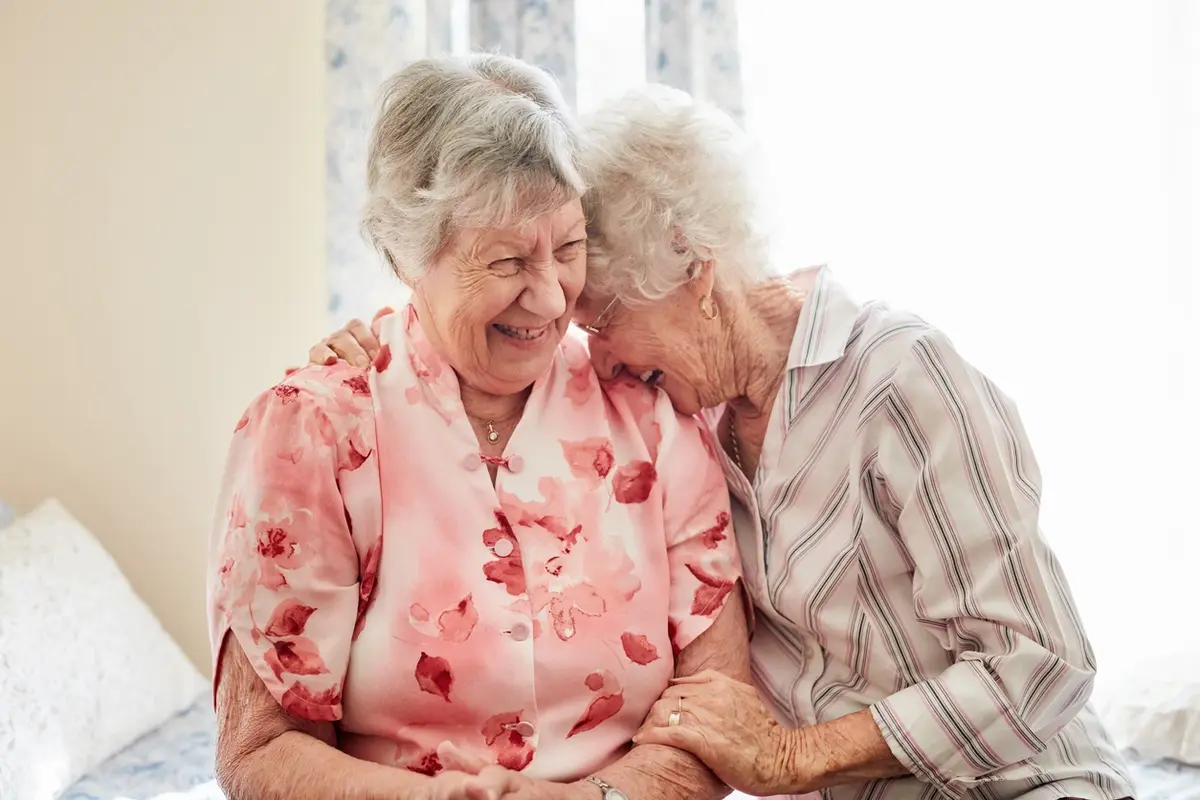
Choosing a shared room is not settling for less. For many residents, it is choosing more of what matters.
Key Takeaways
- Shared rooms in memory care reduce isolation, which research consistently links to faster cognitive decline.
- A familiar roommate provides daily cues that motivate movement, activity, and engagement.
- The presence of another person at night helps reduce sundowning, wandering, and sleep disruption.
- Community living actively alleviates dementia symptoms in ways that home care structurally cannot replicate.
- At Carefield Pleasanton, an all Memory Care community, residents have access to the entire community, not just a locked wing as is common. That distinction matters more than most families realize until they experience it.
According to the Alzheimer’s Association 2024 Alzheimer’s Disease Facts and Figures, more than 7 million Americans aged 65 and older are currently living with Alzheimer’s disease. For families navigating that reality, decisions about memory care, including which room type best serves their loved one, carry real weight.
The Assumption Worth Questioning
When families begin looking at memory care, the instinct toward a private room is almost universal. A private room feels like more. More space, more privacy, more dignity.
The problem is that for someone living with Alzheimer’s or dementia, more space can mean more isolation. And isolation, for a dementia-affected brain, is not neutral.
According to the National Institute on Aging, social isolation in older adults is associated with increased risk of cognitive decline, depression, and earlier mortality. For someone whose cognitive health is already compromised, spending most hours alone in a room is not restful. It is a withdrawal from the very engagement their brain needs most.
A private room with a closed door can feel like independence. In practice, for many residents, it becomes a quiet retreat from a community that is just on the other side of that door.
What a Shared Room Actually Provides
The clinical benefits of shared living in memory care are consistent across research and across communities that offer it.
Daily cueing and motivation. A resident who shares a room sees their roommate getting up, getting dressed, and heading to breakfast. That visible activity is a cue. For someone whose internal motivation has been affected by dementia, external cues matter enormously. A prompt from a familiar presence is often what moves a resident from staying in bed to starting the day.
Companionship eases sundowning. Sundowning, the increase in confusion and agitation that many dementia residents experience in the late afternoon and evening, is one of the most difficult symptoms families and caregivers manage. Knowing someone is nearby at bedtime and waking to a familiar face in the morning helps regulate the anxiety that drives sundowning behavior. That consistency does not replace clinical support. It is a great addition to well-managed medication and professional care.
Reduced nighttime wandering and sleep disruption. The same familiarity that eases sundowning also reduces wandering. Residents in shared rooms tend to sleep more soundly and wake with less disorientation. The mechanism is straightforward: a familiar presence provides an anchor. An anchored mind is a calmer one.
Ongoing social engagement. Research consistently identifies social engagement as one of the most meaningful protective factors against cognitive decline. A shared room does not replace structured programming. But it provides a baseline of daily social contact that a private room, by design, cannot.
If you are still in the early stages of recognizing what is changing in a loved one, our article on Early Signs of Dementia: When to Seek Help walks through what families typically notice first and when to seek a formal evaluation.
Related Article: Best Friends Approach to Memory Care
What Community Living Does for Dementia That Home Care Cannot
The shared-room argument is part of a larger picture. The other part is what a memory care community provides as a whole, for every resident, regardless of room type.
This matters because, for many families, the competition is not between a shared room and a private room. It is between a memory care community and continuing to manage care at home.
Home care provides supervision. It can provide companionship for a few hours at a time. What it cannot provide is the daily structure, consistent peer interaction, and professionally designed environment that a memory care community builds around residents every day.
Structured daily programming. At Carefield Pleasanton, every day includes a scheduled calendar of musical performances, games, readings, art projects, and intergenerational activities. Programming is centered on each resident’s individual interests, not a generic schedule applied equally to everyone. At home, replicating that level of consistent, varied, dementia-appropriate stimulation is not realistic for most families.
Consistent peer interaction. Dining at Pleasanton brings residents together three times a day. Those shared meals are not just about nutrition. They are about conversation, recognition, and the comfort of a familiar group. For a brain affected by dementia, repeated exposure to the same faces and the same routines builds a form of familiarity that is cognitively protective. A home caregiver, however skilled, cannot replicate a community of peers.
Routine and predictability. The Alzheimer’s Association identifies consistent routine as one of the most effective non-pharmacological strategies for managing dementia symptoms. Confusion, agitation, and anxiety all decrease when the day has a reliable, familiar shape. A well-run memory care community builds that structure into every day. Home care, with rotating caregivers and variable schedules, cannot.
Around-the-clock dementia-trained staff. At Carefield Pleasanton, every staff member is trained specifically in dementia care and is available 24 hours a day. At home, coverage gaps are common, and overnight supervision is often inconsistent or absent.
Access to therapeutic activities. Music, art, and intergenerational programming are not extras. They are therapeutic. Research published through the National Institutes of Health supports the role of music-based interventions in reducing agitation and improving mood in people with dementia. These programs are built into the Pleasanton calendar. They are not something a family can easily arrange at home.
Our article on Loving Someone With Dementia covers how the nature of the relationship between a family member and a loved one with dementia changes over time, and what a community environment makes possible for both of them.
What Makes Carefield Pleasanton Different
Most memory care communities operate on a locked unit model. Residents live within a defined, secured perimeter, typically a small wing or a few corridors, and their daily world is limited to that space. The rest of the building is inaccessible to them.
Carefield Pleasanton is designed differently. There is no locked unit.
Residents have access to the entire community. The dining room features floor-to-ceiling windows, an open floor plan, and a visible kitchen. The large inner courtyard is for morning walks and fresh air. On sunny days, the patio has garden planters and, a particular favorite for residents, an outdoor BBQ. The indoor aviary, a reliable gathering point, where exotic birds and the occasional newly hatched egg draw residents back to the same spot every morning. The in-house salon, where residents can get a trim without leaving home. The library and quiet nooks are for the hours when stillness is what they need. The large, light-filled common living spaces are where the day’s activities unfold.
All of it is accessible. All of it is part of daily life.
At some memory care communities, the shared room is the boundary of a resident’s world. At Carefield Pleasanton, the shared room is where a resident sleeps and rests. The rest of the day, the entire community is theirs to move through, eat in, gather in, and live in.
That is genuinely different from how most memory care is structured, and it matters in ways that are visible within weeks of a resident arriving.
Our article on What to Expect When You Transition to Memory Care walks through what the first weeks look like for residents and families, and what makes the difference between a difficult transition and a smoother one.
What Families Worry About
The most common concern is privacy. In a well-run shared room, personal care, including bathing, dressing, and grooming, is always provided privately. Each side of the room is individually arranged, with space for personal belongings, photographs, and the objects that make a space feel like one’s own.
The second concern is compatibility. A shared room only works if the match is thoughtful. At Carefield Pleasanton, sleep patterns, personalities, and care needs are all considered before residents are paired. A well-matched roommate becomes a source of comfort and familiar routine, not a source of friction.
The Financial Reality
Shared rooms in memory care are typically $1,500 to $2,000 less per month than private rooms. Over the course of a year, that is $18,000 to $24,000 in savings with no reduction in the care received.
For many families, that difference determines whether memory care remains financially sustainable over time. Choosing a shared room is not a compromise. It is a financially responsible decision that also aligns with what the research says is clinically better for many residents.
Choosing professional memory care for a loved one when home caregiving has reached its limits is a responsible decision, not a failure. Communities built around memory care have staffing, training, and environments that one family member cannot replicate alone. Families who make this decision early, rather than waiting for a crisis, almost always say they wish they had done it sooner.
The team at Carefield Pleasanton is available to walk you through our shared room options, answer any questions you have, and show you what daily life actually looks and feels like here. A conversation is not a commitment. We are here when you are ready.
Frequently Asked Questions
Should dementia patients share a room?
For many people living with dementia, sharing a room is not just acceptable. It is clinically beneficial. The consistent presence of a roommate provides daily cues for engagement, reduces nighttime anxiety and wandering, and addresses the isolation that research consistently links to faster cognitive decline.
Are shared rooms in memory care as good as private rooms?
For many residents with dementia, shared rooms offer clinical advantages that private rooms cannot. The consistent presence of a roommate provides daily cues for engagement, reduces isolation, and helps regulate nighttime anxiety and wandering. Research consistently links social isolation to faster cognitive decline. A well-matched shared room is not a lesser option. For many residents, it is the better one.
How much less expensive is a shared room in memory care?
Shared rooms in memory care are typically $1,500 to $2,000 less per month than private rooms. Over the course of a year, that represents $18,000 to $24,000 in savings. The care itself does not change. The cost does.
How do memory care communities match shared room residents?
A well-run community considers sleep patterns, care needs, personality, and daily routines before pairing residents. At Carefield Pleasanton, compatibility is part of the placement process. The goal is a match that becomes a source of comfort and familiar routine, not a source of disruption.
Does a shared room mean no privacy?
No. Personal care, bathing, dressing, and grooming are always provided privately. Each resident’s side of the room is their own, with space for personal belongings and meaningful objects. Shared rooms balance individual dignity with the daily companionship that benefits residents most.
What makes Carefield Pleasanton’s shared rooms different from other memory care communities?
In most memory care communities, residents are confined to a small, secure unit. At Carefield Pleasanton, there is no locked unit. Residents have access to the entire community throughout the day: the dining room, outdoor courtyard and patio, aviary, salon, library, and all common living spaces. The room is where they rest. The rest of the day, the whole community is theirs.