
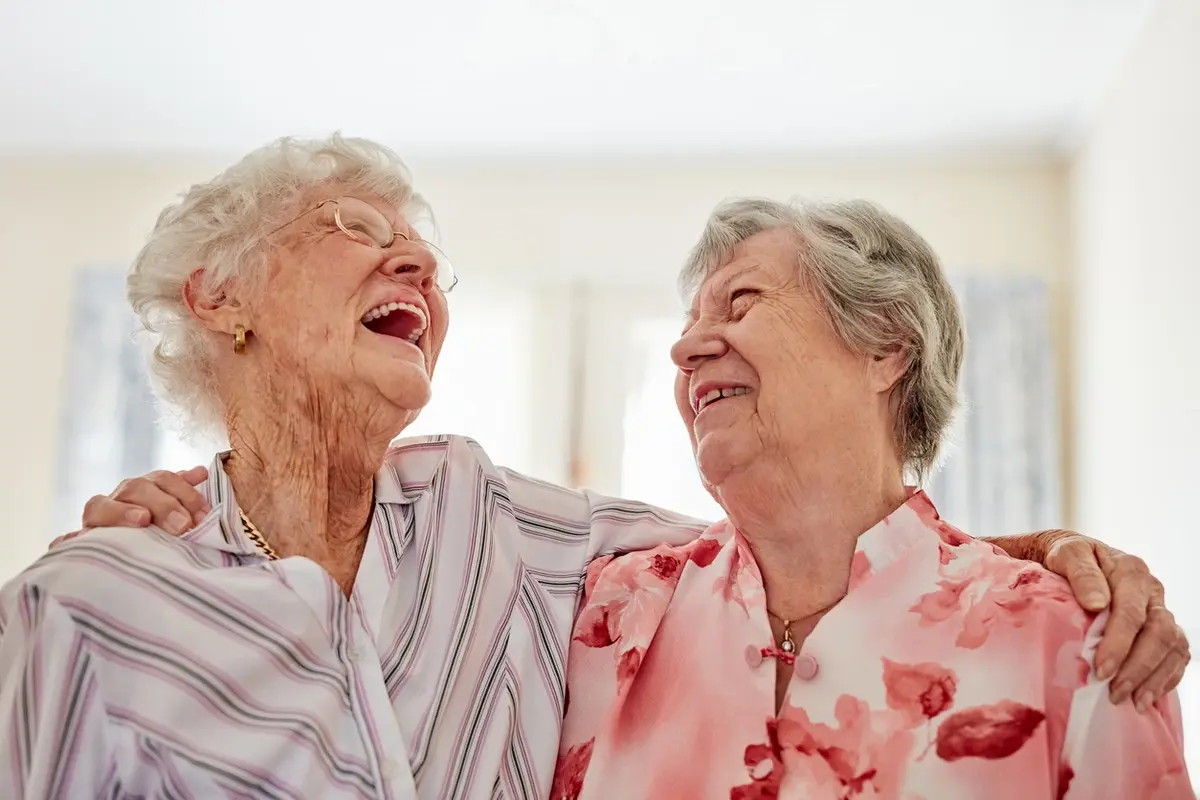
The Best Friends Approach to memory care is a person-centered care philosophy developed by Virginia Bell and David Troxel in the 1990s. It holds that what a person with dementia needs most is a genuine best friend: someone who knows their life story, meets them where they are, and maintains a relationship built on empathy, trust, and consistent positive connection.
Most families spend the early weeks after a dementia diagnosis focused on safety. The medication schedule. The wandering risks. The moments that feel dangerous. All of that matters.
What the Best Friends Approach adds to that picture is a different kind of question: not just how do we keep this person safe, but how do we keep them known?
The answer, it turns out, changes what memory care looks and feels like for everyone involved.
What Is the Best Friends Approach to Memory Care?
The Best Friends Approach is a philosophy of dementia care built on one central idea: the quality of the relationship between a caregiver and a person with dementia determines the quality of daily life more than almost anything else.
A “best friend” in this model is not necessarily a lifelong companion. It is anyone (a family member, a staff caregiver, a fellow resident) who brings five specific qualities to every interaction: empathy, respect, support, trust, and humor. Someone who knows the person’s life story and draws on it naturally. Someone who meets them where they are rather than correcting or redirecting. Someone whose presence consistently communicates: you are known, you are valued, and you are safe here.
That consistent message is not just emotionally meaningful. Research published through the Alzheimer’s Association supports the connection between positive social relationships and reduced agitation, improved mood, and better daily function in people with dementia. The Best Friends Approach is how that connection is put into daily practice.
Who Developed the Best Friends Approach?
Virginia Bell and David Troxel developed the Best Friends Approach in the 1990s while working at the University of Kentucky Alzheimer’s Disease Research Center. Their foundational text, The Best Friends Approach to Alzheimer’s Care, published by Health Professions Press, laid out the framework that has since been adopted by memory care communities across the country.
Bell and Troxel’s core insight was that dementia does not erase the need for human connection. It changes how that connection must be offered. A person who cannot remember a caregiver’s name may still feel safe in their presence. A person who cannot follow a complex conversation may still respond to humor, music, or a familiar story from their past. The approach is built around those preserved capacities, not around what has been lost.
The Life Story: Why Knowing Someone Is the Foundation of Good Care
At the center of the Best Friends Approach is the concept of the life story: a detailed understanding of who a person has been throughout their life, what they valued, what they loved, what made them laugh, what their daily rhythms looked like before dementia changed them.
A caregiver who knows that a resident spent forty years as a teacher approaches them differently than one who does not. A caregiver who knows that someone grew up near the ocean, that they raised three children, that they played piano until their seventies, has a toolkit of connection points that no static care plan can fully capture.
At Carefield Pleasanton, learning each resident’s life story is not a one-time process during intake. It is the ongoing work of every caregiver, in every shift. Our article on How to Build a Personalized Music Playlist for a Loved One with Dementia is an example of what a loved one or caregiver can do for a resident when they have knowledge about their life story. In this way, a playlist built around a resident’s history in not only entertainment. It is a relationship tool.
How the Best Friends Approach Works in Practice
The Best Friends Approach changes how caregivers respond in the small moments that make up most of dementia care.
Meeting the person where they are. When a resident believes they need to pick up their children from school, a Best Friends caregiver does not correct the timeline. They acknowledge the feeling behind it. “You always took such good care of them” goes further than “That was decades ago.”
Letting go of corrections. Constant redirection increases anxiety and confusion for people with dementia. Consistent validation, even of things that are not literally true, reduces agitation and maintains trust.
Keeping the person involved. Even small decisions, which shirt to wear, whether to sit in the courtyard or the living room, what to have for breakfast, preserve a sense of agency that matters enormously for emotional well-being.
Using humor gently. Laughter is one of the most reliable paths to connection across cognitive change. A caregiver who shares a small, warm joke at the right moment builds more trust than ten technically correct care interactions.
Our article on Tips for Communicating with a Loved One Experiencing Memory Loss goes deeper into the specific communication strategies that align with the Best Friends model.
Why the Physical Environment Matters
The Best Friends Approach cannot fully function in a confined space. Genuine friendship requires movement, variety, and the natural moments that happen when people share a broader daily world.
Most memory care communities operate within a locked unit: a few corridors, a limited common area, and the same small perimeter every day. The Best Friends approach can happen within those walls, but it is constrained by them.
Carefield Pleasanton is designed differently. Residents have access to the entire community. The dining room with its floor-to-ceiling windows and visible kitchen. The large inner courtyard for morning walks. The outdoor patio with garden planters and BBQ. The indoor aviary, a particular favorite and one of the community’s most entertaining amenities, where exotic birds and the occasional newly hatched egg draw residents back to the same spot day after day. Bird watching is a multi-sensory experience: the movement, the color, the chirps and songs all work together to ground residents in the present moment and ease the anxiety that memory loss so often brings. For residents for whom conversation has become hard, the aviary offers something quieter and just as connecting.
When the whole community is a resident’s daily world, the opportunities for genuine connection multiply. A caregiver and resident who walk through the courtyard together, who stop at the aviary, who sit in the sun for a few minutes without an agenda, are living the Best Friends Approach, not just practicing it.
Shared Living as an Expression of Best Friends
The Best Friends Approach does not end when a caregiver’s shift ends. For residents who share a room, it continues through the presence of a roommate who has become genuinely familiar.
A well-matched roommate knows when their neighbor seems off today. They provide a consistent human presence at night, exactly when anxiety and disorientation are most likely to rise. The everyday familiarity between two people sharingpersonal space is one of the most natural expressions of the Best Friends model in a community setting.
Our article on shared rooms in memory care covers the full picture of why shared living often produces better outcomes for residents with dementia, and how Carefield Pleasanton approaches roommate matching to support exactly this kind of ongoing connection.
What the Best Friends Approach Means for Families
For families, the Best Friends Approach offers something that clinical care language rarely provides: hope.
The fear that accompanies a dementia diagnosis is often the fear of losing the relationship. That the person you love will no longer recognize you, will no longer be reachable, will no longer be there in any meaningful sense. The Best Friends Approach challenges that fear directly. The connection does not disappear. It changes form. And with the right approach, a great deal of it can be preserved.
Families who visit a loved one at Carefield Pleasanton often describe the same experience: their family member does not always know the date or season, but they know when someone they trust has walked into the room. They reach for a hand. They smile at a familiar voice. The relationship is still there.
Our article on Pet Therapy in Memory Care: Benefits of Animal Companionship for Seniors explores another dimension of this: how non-verbal connection through animals draws on the same capacities the Best Friends Approach relies on. Carefield Pleasanton does not have resident pets, but animals come to the community. When horses from the East Bay Regional District Mounted Police and the Livermore Mounted Police visited recently, something shifted. Residents who spend most of their day indoors came outside, reached out a hand, and did not want to leave.
Choosing a memory care community that genuinely practices this philosophy changes what daily life looks like for a resident. It changes what visits feel like for families. And it changes what the years ahead hold for everyone.
Choosing professional memory care for a loved one when home caregiving has reached its limits is a responsible decision, not a failure. The team at Carefield Pleasanton is available to answer any questions and show you what the Best Friends Approach looks like in practice here. If you are ready to take the next step, we are here.
Frequently Asked Questions
What is the Best Friends Approach to dementia care?
The Best Friends Approach to dementia care is a person-centered philosophy that holds the quality of the relationship between a caregiver and a person with dementia as the foundation of good care. Developed in the 1990s, the approach trains caregivers to act as genuine best friends: people who know the resident’s life story, meet them where they are emotionally and cognitively, and consistently communicate empathy, trust, and respect. It is designed around what dementia preserves, including emotional memory and the capacity for connection, rather than only around what it takes away.
Who developed the Best Friends Approach?
Virginia Bell and David Troxel developed the Best Friends Approach in the 1990s while working at the University of Kentucky Alzheimer’s Disease Research Center. Their founding book, The Best Friends Approach to Alzheimer’s Care, published by Health Professions Press, remains the foundational text. Bell and Troxel’s central insight was that a person with dementia does not stop needing genuine human connection. They need it offered in a different way: through familiarity, life story knowledge, humor, and consistent positive presence rather than through cognitive demands the disease has made inaccessible.
How does the Best Friends Approach benefit residents with dementia?
Residents who receive care through the Best Friends Approach consistently show lower rates of agitation, stronger daily engagement, and better overall mood than those in purely task-oriented care environments. The approach reduces disorientation from constant correction, builds emotional safety through repeated positive interactions, and preserves a sense of agency and dignity even as cognitive function changes. For families, it means visiting a loved one who, even when they cannot remember the date or the season, clearly knows when someone they trust is in the room.
Can families use the Best Friends Approach at home?
Yes. The principles of the Best Friends Approach are fully applicable in family caregiving. Learning a loved one’s life story, letting go of corrections, meeting them emotionally where they are, keeping them involved in small decisions, using humor gently, and communicating simply are all strategies families can use in daily interactions. Our article on Tips for Communicating with a Loved One Experiencing Memory Loss covers practical guidance for exactly this kind of everyday connection.