
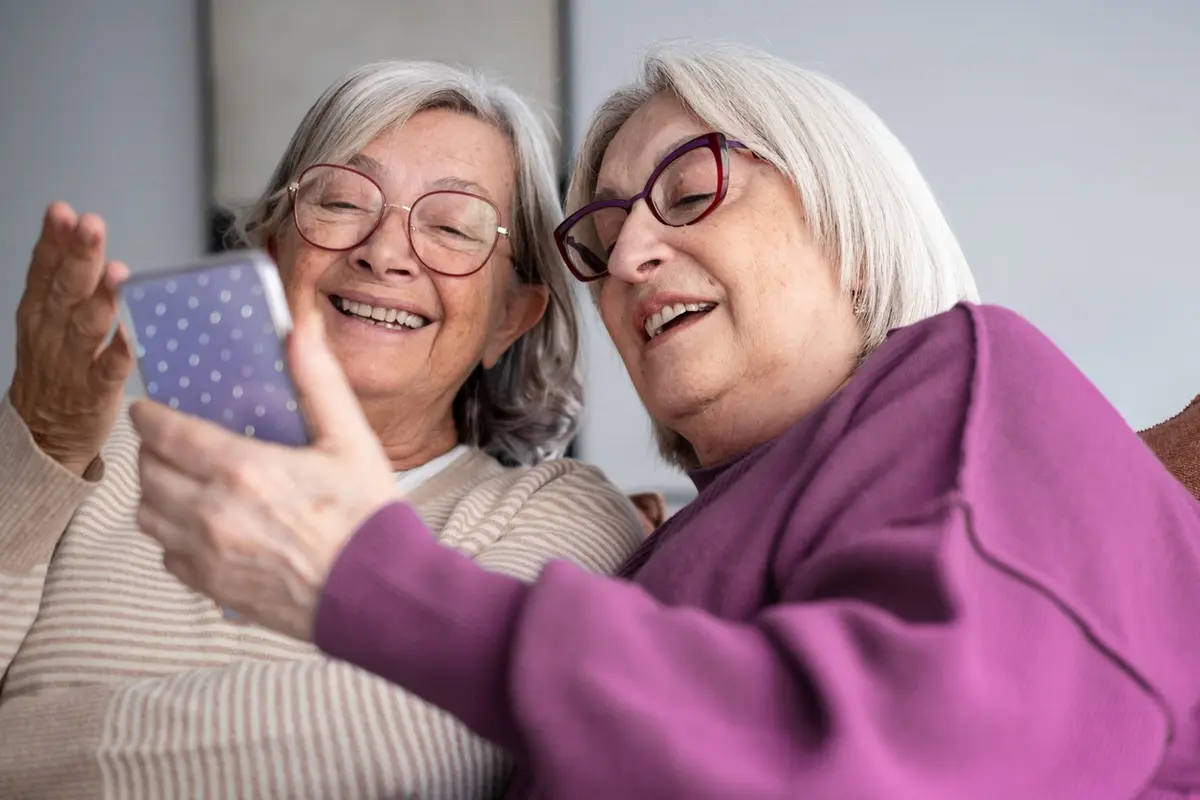
A companion suite is a shared memory care apartment designed for two residents, each with their own personal space, at a lower monthly cost than a private suite. At Carefield Pleasanton, companion suites start at $6,295 a month, compared to $8,495 for the same footprint as a private suite. The difference is not the room. It is whether a resident shares it, and with careful matching, that difference often becomes a genuine benefit rather than a compromise.
Families researching memory care tend to assume private is simply better, and more expensive automatically means more comfortable. Neither assumption holds up once you look at what a companion suite actually does for a resident.
Key Takeaways
- A companion suite pairs two memory care residents in one apartment, each with personal space, at a lower monthly cost than a private suite.
- At Carefield Pleasanton, companion suites start at $6,295 per month, versus $8,495 for a private suite of the same size, representing roughly a 26% savings.
- Roommates are matched thoughtfully by staff who already know both residents, rather than being assigned to whichever room happens to be open.
- Research on dementia care points to purpose and social connection as basic needs that persist through the disease, needs that a well-matched companion suite can help meet.
- A poor match is not permanent. Communities that take matching seriously are also willing to adjust it.
What a Companion Suite Actually Is
A companion suite is not a hospital-style shared room split by a curtain. At Carefield Pleasanton, it is a memory care apartment built for two residents, with defined personal space for each, sharing the same living area, the way a private suite resident would use theirs alone.
The appeal starts with cost. Two residents sharing a suite means each pays less than the cost of a private suite of the same size, without sacrificing the level of care, staffing, or access to programming. For families weighing memory care against a fixed budget, that gap can be the difference between a community that fits and one that does not.
Cost is only half the picture, though. The other half is who a resident shares that space with, and how thoughtfully that pairing is made.
Why Matching Matters More Than the Room Itself
Two residents placed together at random and two residents matched thoughtfully can have completely different experiences in the exact same suite. At Carefield Pleasanton, staff who already know both residents, their routines, their personalities, and their sleep patterns, weigh in on a pairing before it is made. This is not a formality. It is the difference between a companion suite that works and one that does not.
Research on nursing home roommate pairings backs up why this matters. A National Bureau of Economic Research working paper covering 2.6 million nursing home stays found that a resident’s health outcomes are meaningfully affected by who they are paired with, not simply whether they have a roommate at all. The room is identical either way. The match is not.
In memory care, every resident is living with some change in cognition, so matching is not about pairing a resident with dementia with someone who does not have it. At Carefield Pleasanton, memory care residents share with other memory care residents, not with assisted living residents. Within that group, Carefield Pleasanton treats roommate pairing as a clinical judgment rather than a logistical matter.
What Companionship Actually Offers a Resident With Dementia
Purpose and connection do not disappear with a dementia diagnosis. Teepa Snow, one of the most widely respected educators in dementia care, has long taught that people living with dementia still need a sense of being useful and valued, not just supervised. A well-matched companion suite can meet that need in ways a private suite cannot.
A roommate provides a steady, low-pressure presence throughout the day: someone getting up when they do, someone at the next meal, someone whose lamp is still on if they wake at 2 a.m. For a resident who spent decades sleeping near a spouse or a sibling, that presence can matter more than privacy ever would. It also gives residents something to look out for besides themselves, a role, however small, that a private suite does not offer.
None of this happens automatically. It happens when a community pairs people with intention.
What If the Match Isn’t Right?
A thoughtful match is not the same as a guaranteed one. Personalities shift, needs change, and a pairing that made sense at move-in does not always stay the right fit.
At Carefield Pleasanton, a companion suite pairing is never treated as permanent by default. If a relationship between roommates is not working, the community reassesses and works with the family to adjust the arrangement. Families should ask the community directly how they handle this, not just how they make the initial match.
Sensory environment, sleep needs, and how a resident has lived before all factor into whether private or shared rooms in memory care are a better fit for a specific person, and the right answer is rarely the same for every resident. The research on why shared rooms work in memory care goes beyond matching alone, encompassing emotional regulation, family peace of mind, and the daily rhythm that shared living creates.
Frequently Asked Questions
1. What is the difference between a companion suite and a private suite?
A companion suite houses two residents in the same memory care apartment, each with their own personal space, while a private suite houses one. At Carefield Pleasanton, both are the same size, and the primary differences are cost and whether a resident shares the space with a roommate. Companion suites start at $6,295 a month, compared to $8,495 for a private suite.
2. Are companion suites cheaper than private rooms in memory care?
Yes. At Carefield Pleasanton, a companion suite starts at $6,295 a month compared to $8,495 for a private suite of the same footprint, roughly a 26% savings. Two residents sharing the cost of one apartment is the main reason companion suites are more affordable, without any reduction in care level or staffing.
3. How are roommates matched in a companion suite?
At Carefield Pleasanton, staff who already know both residents, including their routines, personalities, and care needs, are involved in the pairing before a match is made. This matters more in memory care than in other settings, since residents living with dementia cannot always advocate for what is or is not working. If a pairing is not successful, the community reassesses and adjusts.
4. Do companion suites help reduce loneliness in memory care?
Often, yes, when the match is right. A roommate provides a steady, low-pressure presence throughout the day and night, which can ease anxiety and give residents a sense of purpose that comes from looking out for someone else. The benefit depends heavily on thoughtful matching. A poorly matched pairing does not yield the same result, which is why the matching process matters as much as the decision to choose a companion suite.