The Benefits of Community Care in Summer for Older Adults and Their Families
Senior community care during summer provides critical relief from heat-related health risks, prevents seasonal isolation, and keeps older adults safely active. Communities offer climate-controlled environments, hydration management, and engaging activities tailored to warmer weather, while giving primary caregivers essential respite during the most demanding months of the year.
Summer is when most families realize they have been managing more than they thought.
The heat changes things. The disrupted routine changes things. The long afternoons that are harder to fill, the hydration that needs to be tracked, the medications that need to stay at the right temperature. All of it lands at once. And the person managing it is usually one family member, doing it alone, without backup.
Community care in summer changes that picture entirely.
The benefits of community care are present in every season. Summer is simply when they become impossible to overlook.
Key Takeaways
- The benefits of community care in summer include consistent hydration monitoring by trained staff, structured daily activity adapted to warmer weather, climate-controlled environments, and caregiver respite that solo home care cannot provide.
- Older adults with dementia or cognitive impairment cannot reliably recognize or communicate thirst, making professional hydration monitoring one of the most clinically significant summer care advantages a senior living community provides.
- The National Institute on Aging identifies older adults, particularly those with cognitive impairment, among the highest-risk groups for heat-related illness, with heat stroke being a medical emergency that can develop quickly in this population.
- Social isolation deepens in summer for older adults without structured daily programming. Community care addresses isolation structurally through meals, activities, and shared daily life rather than through scheduled visits.
- The Ojai Meadows offers both assisted living and memory care through the small house model in Ojai, California, with year-round dining, outdoor patios, and a lifestyle program built on five pillars: move, engage, feel, connect, and eat.
Why Summer Is Harder Than Most Families Expect
Summer places compounding demands on older adults and their caregivers that do not announce themselves all at once. Heat affects the aging body differently than it affects younger adults. The ability to regulate temperature through sweating decreases. Thirst signals become less reliable. Medications sensitive to temperature need careful storage. And for older adults who spend significant time at home, summer can deepen an isolation already present in other seasons.
For older adults with dementia or cognitive decline, the risks are sharper. A person who cannot reliably recognize that they feel hot will not seek shade. A person whose thirst signals have faded will not ask for water. These are not moments of forgetfulness. They are the predictable effects of how dementia changes the brain’s ability to process and communicate physical experience.
Increased confusion or agitation in the late afternoon and evening during summer can signal heat exposure, dehydration, or a disrupted routine. Our article on sundowning explains what drives these episodes and how structured daily environments consistently reduce them.
The Benefits of Community Care in Summer: Safety Built Into Every Day
One of the most significant benefits of community care in summer is that heat safety and hydration management are built into the daily care structure, not dependent on a family caregiver’s continuous presence. Staff in a professional senior living community offer fluids throughout the day as a standard care routine, not as a response to a resident saying they are thirsty. They are trained to recognize early signs of dehydration and heat stress before symptoms become serious.
According to the National Institute on Aging, older adults are at elevated risk for heat-related illness because aging reduces the body’s ability to regulate temperature and because many medications commonly taken in this population affect heat response. Cognitive impairment increases the risk further by impairing the recognition and communication of discomfort.
Medications are managed within a climate-controlled professional system. Indoor environments are maintained appropriately for the season. Outdoor programming is scheduled during cooler morning hours. Afternoon activities move indoors without disrupting the consistent routine that dementia residents depend on to stay oriented. For families who have been managing medications alongside everything else, our article on managing medication for your loved one covers what professional oversight looks like and why it changes daily life for both the resident and the family.
What Summer Activities Look Like in Professional Senior Care
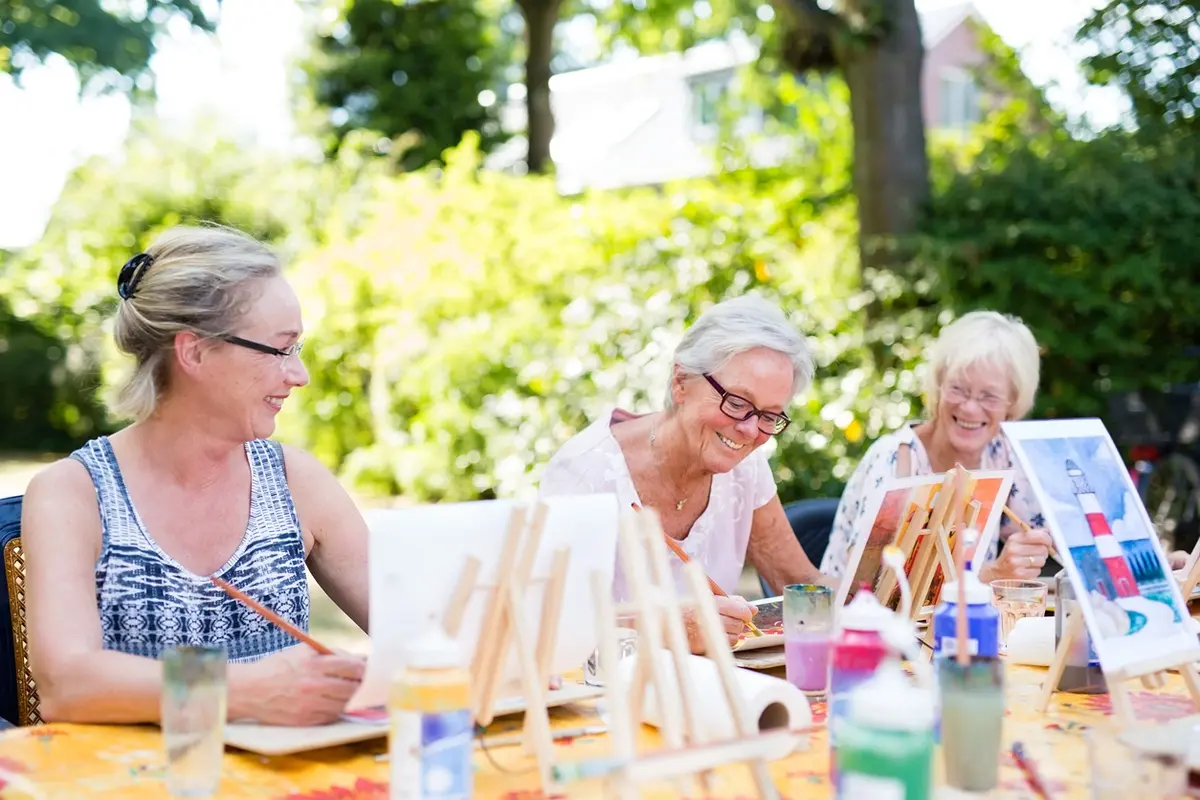
Community care in summer provides structured daily programming that prevents the seasonal isolation and cognitive disengagement that extended home-based care cannot address. A private caregiver, however dedicated, cannot replicate what a full daily community calendar provides: shared meals, morning walks before the heat peaks, afternoon art and music indoors, and evening patio time as temperatures drop. Ojai Meadows replaced its fenced pool with something residents can actually use: an open central courtyard with a shade structure and newly planted trees that have already become one of the most-used gathering spaces in the community.
These are not occasional events. They are the shape of the day. For older adults at home without this structure, summer can stretch into long, isolating stretches of time that increase restlessness, anxiety, and cognitive decline. Research consistently links social isolation to accelerated cognitive decline and worsened behavioral symptoms in people with dementia. The absence of structured engagement during summer is not neutral in its effects.
The Alzheimer’s Association Daily Care Plan recommends building consistent structured activity around a person’s natural daily rhythms. In summer, that means programming adapts to the heat without altering the routine’s shape. In a professional community, that adaptation is planned. At home, it depends entirely on whoever is present and what they can sustain. Our article on the benefits of a loved one living in a community for adults with dementia covers the full picture of what community living provides that family caregiving alone cannot replicate.
The Relief Families Often Do Not See Coming
When a loved one moves into professional senior care, family caregivers describe a specific kind of relief that builds over the first few weeks and is difficult to anticipate. They stop tracking the medication schedule remotely. They stop calling to confirm whether lunch happened. They stop lying awake worrying about whether the house is cool enough on a hot July night.
The worry does not disappear. But it changes shape. It becomes something shared with a trained professional team rather than something carried alone. In summer, especially when the heat, long days and disrupted routine add weight to caregiving that was already significant, this shift is felt immediately.
Families who have moved a loved one to professional care during the summer consistently describe arriving for visits differently than they arrived as caregivers. They are present as a family. That shift is one of the things most families say they wish they had found sooner. Our guide on transitioning to senior living walks through what that process typically looks and feels like and what makes it more manageable than most families expect.
What the Benefits of Community Care Look Like at Ojai Meadows
Ojai Meadows delivers the benefits of community care in the summer through a small-house model and lifestyle program specifically designed to make daily life meaningful, safe, and appropriately paced for the season. With our community improvements near completion, the community is welcoming new residents in both assisted living and memory care.
The Small House Model in Summer
Ojai Meadows is built on the small-house model: five individual buildings in the Spanish Colonial Revival style, each building with 16 apartments and its own living room, dining room, and kitchen. That scale means caregivers know their residents with the specific, personal knowledge that only comes from daily proximity. In summer, that knowledge translates directly into safer care: a caregiver who knows a resident’s baseline notices earlier when something is off.
Summer Programming Across Five Pillars
Ojai Meadows’ lifestyle program is built on five pillars: move, engage, feel, connect, and eat. In summer, each adapts to what the season allows.
Morning activity can take place on the central patio and inside if air conditioning is needed before the heat arrives. The newly renovated central patio and the Topatopa mountain views create a morning environment that is genuinely worth stepping outside for. Afternoon programming can move to cooler indoor common spaces for art, music, readings, and creative activities. Evening draws residents back outside as Ojai settles and the surrounding peaks catch the light of the famous pink moment.
The five pillars do not pause in summer. They shift with it.
Organic and Seasonal Dining
Ojai Meadows’ culinary program uses organic and locally grown ingredients, including seasonal produce from Ventura County’s agricultural region through summer. Hydrating summer fruits and foods are naturally woven into every meal. Hydration is part of the daily dining routine and the ongoing care structure, not a reactive response to symptoms. For a community serving residents who may not recognize their own thirst, that structural approach is meaningful.
Choosing professional care for a loved one when home caregiving has reached its limits is a responsible decision, not a failure. Communities like Ojai Meadowss have staffing, training, physical design, and seasonal programming that no single family member can replicate alone. Families who make this decision before a difficult summer enjoy a smoother transition and something unexpected: they get to be a daughter or son again, not a caregiver managing every daily detai. The team at Ojai Meadows is here to answer questions at whatever pace feels right for your family. This is not a commitment. It is a conversation.
Frequently Asked Questions
What are the benefits of community care in summer for older adults?
The benefits of community care in summer include professional hydration monitoring, climate-controlled environments, heat-adapted daily programming, consistent medication management, and structured social engagement that prevents seasonal isolation. For older adults with dementia who cannot reliably recognize or communicate thirst or heat discomfort, professional community care provides a structural safety net that family caregiving at home cannot replicate around the clock. Summer also provides caregiver respite, freeing family members from the compounding daily demands that heat season adds to an already significant caregiving role.
Why is hydration especially critical for seniors with dementia in summer?
Older adults experience reduced thirst sensation as a natural result of aging. Dementia compounds this by impairing the brain’s ability to reliably process and communicate physical discomfort. A person who cannot feel or articulate the need for water will not ask for it. Dehydration in people with dementia can present as sudden cognitive worsening, including increased confusion, agitation, and behavioral change. Professional community care embeds hydration monitoring into the daily routine for every resident, not as a response to visible symptoms but as a prevention standard.
How does senior community care help with summer isolation?
Summer deepens isolation for older adults at home who lack structured daily programming. Community care addresses this structurally: shared meals three times daily, morning activities, afternoon programming, and evening social time create consistent peer interaction that occasional visits cannot replace. The Alzheimer’s Association identifies social engagement as one of the most effective strategies for reducing agitation and supporting daily function in people with dementia. A community provides that engagement as a daily constant, not an exception.
What activities does Ojai Meadowsoffer in summer?
Ojai Meadows’ lifestyle program adapts its five pillars (move, engage, feel, connect, eat) for the summer season. Morning activities and outdoor time on the central patio take place during cooler hours. Afternoon programming can move indoors for art, music, readings, and creative sessions in climate-controlled common spaces. In the evening, residents can gather outside as temperatures cool and catch a last glimpse of the Topatopa Mountains. Fresh and locally source seasonal ingredients make for healthier and more hydrating summer meals.
Is summer a good time to tour Ojai Meadows?
Summer is one of the most revealing times to visit. The outdoor spaces are in daily use, the programming calendar is fully active, and the care team’s approach to seasonal safety is visible in the daily routine rather than described in a brochure. Ojai Meadows welcomes families who want to see daily life in action before making any decisions.