
Senior living community outings keep assisted living and memory care residents socially engaged, physically active, and connected to the communities they come from. Regular trips to local parks, cultural sites, and neighborhood destinations address isolation structurally, maintaining the sense that life is still happening outside the building. In-house programming, cooking demonstrations, wellness partnerships, and community visitors fill the days between outings with genuine texture.
Most people picture assisted living and memory care as a building. A place where older adults live, with meals and care handled inside. What they rarely picture is what happens when the doors open.
At Carefield Castro Valley, the doors open regularly. A lakeside picnic at Lake Chabot. A cooking demonstration where a caregiver shares her recipe for Pancit. A therapy dog working his training rounds on a Tuesday. A Wellness in Motion class that turned into a weekly fixture because people liked it enough to keep coming back.
These are not field trips planned to fill a brochure. They are what a week can look like when the community is part of a neighborhood, not separate from it.
Senior living community outings change something that amenities alone cannot: the feeling that life is still happening, and that you are still part of it.
Key Takeaways
- A 2023 study published in JAMA Network Open found that older adults who regularly participated in enriching activities were significantly less likely to develop dementia and showed stronger cognitive resilience over time.
- The National Institute on Aging identifies social isolation and loneliness as serious health risks for older adults, linked to higher rates of cognitive decline, depression, heart disease, and premature mortality.
- A 2025 U.S. News survey found that among seniors who reported loneliness before their move, senior living consistently helped them maintain or improve health and find meaning and enjoyment in daily life.
- Outings and community programming in assisted living and memory care do something in-building activities cannot: they place residents back in the world they came from, maintaining the sense of continuity that supports emotional well-being.
- Carefield Castro Valley sits at the foot of Mount Diablo in the East Bay, with access to regional parks, community centers, and the cultural fabric of a neighborhood that residents already know and feel at home in.
What Senior Living Community Outings Look Like
Senior living outings are not transportation-and-activity logistics. They are one of the clearest expressions of what a community believes residents still deserve. A trip to a lake, a visit to a botanical garden, an afternoon at a local event: these are not gestures. They are answers to the question every older adult is quietly asking when they consider assisted living or memory care: will I still have a life, or will I be managed?
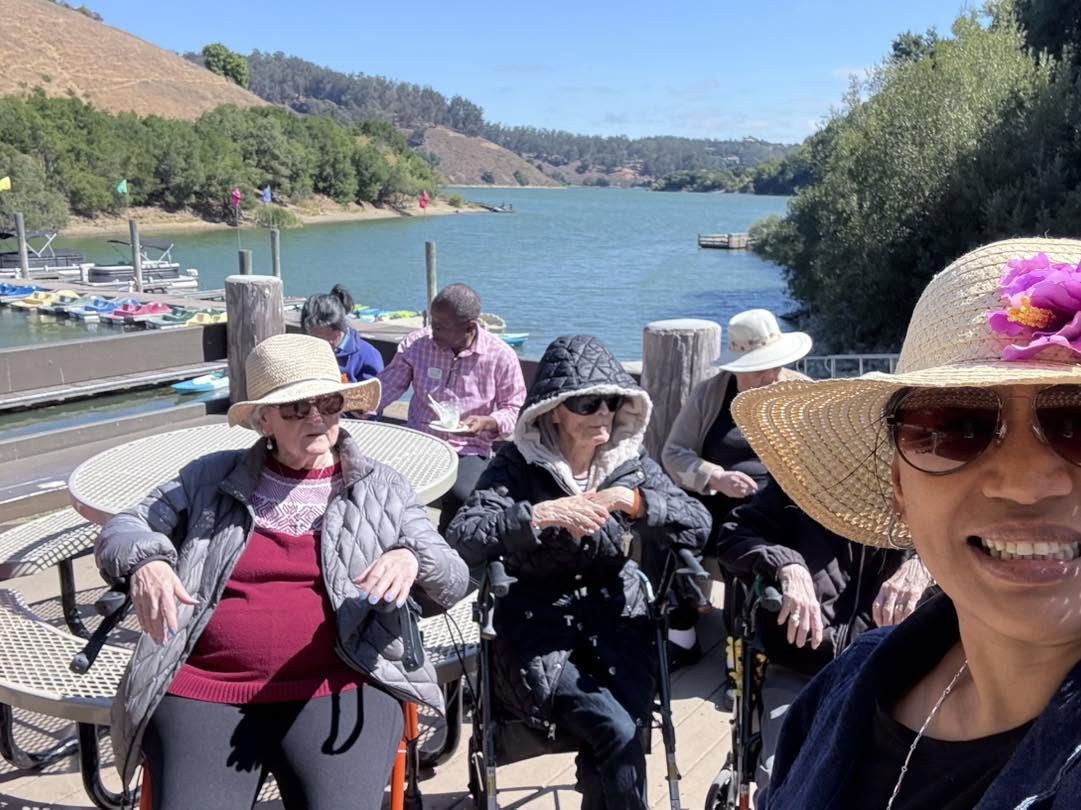
On a sunny Thursday, Carefield Castro Valley took a group of residents to Lake Chabot for a lakeside picnic. The lake that day was full. Other families had the same idea, and residents sat at picnic tables with fresh flowers in the center and water bottles, surrounded by the ordinary summer life of the East Bay: children running, other groups spreading blankets on the grass, people passing on the paths with dogs. A few residents made their way along the paths through the park, unhurried, in the sun.
Nobody was managing anything. They were just outside.
The National Institute on Aging identifies social isolation as a serious health risk for older adults, linked to higher rates of cognitive decline, depression, and premature mortality. Community outings address that risk directly: they place residents back in the broader world, in familiar settings, alongside people and places they already know. That is not incidental. It is one of the most practical things a senior living community can do for the people in its care.
Lake Chabot is not a generic destination. It is a specific, beautiful piece of the East Bay that people who have lived in this area have walked, fished, and picnicked beside for decades. Going back to it is not just recreation. For many residents, it is the continuation of something familiar. The team is already planning the next one.
Our article on Why Social Activities in Assisted Living Change Everything for Seniors covers the research on what consistent social engagement does for residents across the course of a year.
The Programming That Fills the Week
What happens on the days between outings tells you as much about a senior living community as the outings themselves. A single memorable event is easy to arrange. A week that has genuine texture, that gives residents something to look forward to, is harder to build and much easier to feel when you visit.
Cooking Demonstrations and Cultural Programming
One of Carefield Castro Valley’s caregivers Eugenia led a cooking demonstration for residents, sharing her recipe for Pancit, the Filipino noodle dish that has been a fixture in her family for generations. Cooking brings people together across a shared sensory experience: the smell of the kitchen, the texture of ingredients, the anticipation of tasting something made together. For residents from Filipino families, it offered something more immediate, the specific pleasure of a flavor that belongs to a memory.
Multicultural programming is not a checkbox. It is the community acknowledging that its residents come from specific places, with specific histories. That acknowledgment produces connection in ways that universal programming rarely achieves.
Wellness Partnerships
We recently welcomed a new class, Wellness in Motion, offered through CityServe of the Tri-Valley Volunteers. The class will return every Tuesday from August through September for residents who want structured, social movement as part of their week. It is the kind of programming that emerges from a community that actively cultivates relationships in its neighborhood, not just within its walls.
The Unexpected Visitors
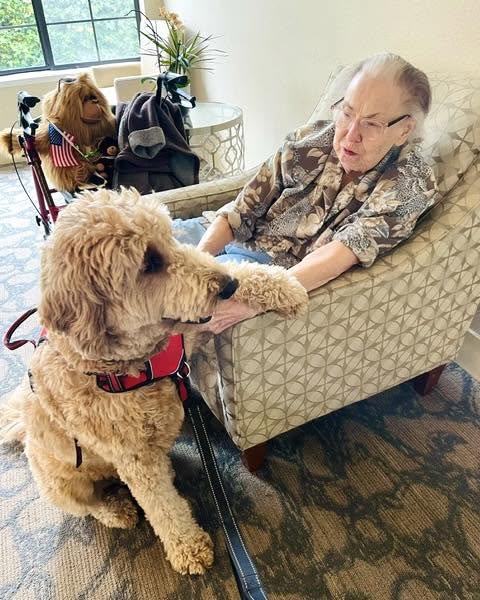
Cooper, a therapy dog in training, stopped by Castro Valley recently, belonging to the family member of one of the residents. These visits are not scheduled program items. They are what happens when a community is open enough to make room for them. A well-behaved dog moving through the common areas, drawing residents out of their rooms and into conversation, does something no organized class can replicate.
Our article on Activities in Assisted Living That Make Life More Meaningful covers the full range of programming that shapes a resident’s week at Castro Valley.
Why the East Bay Location Makes These Outings Possible
Carefield Castro Valley’s location in the East Bay is not just a geographic convenience. It is part of what makes community-based programming genuinely possible. The community sits at the foot of Mount Diablo, between the Bay Bridge and the San Mateo Bridge, with regional parks, cultural centers, and familiar neighborhoods within easy reach.
For older adults who have spent decades in the Bay Area, an outing to Lake Chabot or a visit to the Castro Valley Veterans Memorial is not a trip to somewhere unfamiliar. It is a return to somewhere they already belong. That distinction matters. Research on aging consistently shows that continuity of place, maintaining connection to familiar locations and community identities, supports emotional wellbeing in ways that novel experiences alone do not.
Castro Valley residents visit the Hayward Japanese Gardens. They attend local events. They move through their region with the community behind them rather than leaving it behind.
Our article on Why Castro Valley Is One of the Best Places in the Bay Area for Senior Living covers what the East Bay specifically offers for older adults and their families.
What Community Programming Means for the Residents’ Families
When a family member visits someone in assisted living and memory care, the quality of that visit depends on what the person they are visiting has been doing. A resident who spent a sunny Thursday afternoon at Lake Chabot has something to talk about. A resident who attended Eugenia’s Pancit demonstration has a story to tell. A resident who has been to Wellness in Motion that week feels different in their body than one who has not moved much at all.
Family visits change when the person being visited is engaged in their own life. The visit stops being a welfare check and starts being an actual visit. Families describe this shift in similar terms across almost every community where programming is strong: they got to be a daughter or son again, not someone arriving to assess a situation.
Our article on What Is Assisted Living and Who Is It For? addresses the common assumptions families bring to their research and what tends to change once they visit.
Choosing professional care for a loved one when home caregiving has reached its limits is a responsible decision, not a failure. Communities like Carefield Castro Valley have staffing, training, neighborhood connections, and programming that one family member cannot replicate alone. Families who make this decision before urgency makes it for them almost always say they wish they had done it sooner. The team at Carefield Castro Valley is here to answer questions at whatever pace feels right. This is not a commitment. It is a conversation.
Frequently Asked Questions
1. What kinds of outings do assisted living and memory care communities offer?
Assisted living and memory care communities vary widely in how actively they connect residents to the world outside the building. The strongest programs include regular group outings to local parks, cultural sites, community events, and familiar neighborhood destinations, alongside in-house programming like cooking demonstrations, visiting performers, therapy animal visits, and wellness classes led by community partners. At Carefield Castro Valley, that mix shows up on the calendar every week, not just for special occasions.
2. Do assisted living and memory care residents still get to go outside the community?
Yes. In a well-run assisted living and memory care community, group outings are a regular part of the programming calendar, not an occasional special event. Residents board community transportation with staff support and visit local parks, cultural venues, community events, and familiar neighborhood destinations. When evaluating an assisted living and memory care community, asking specifically about recent outings, where they went and how often, gives a clearer picture of daily life than reviewing the amenities list alone.
3. Will my parent feel at home in assisted living if they have lived in the same area for decades?
Familiarity with the surrounding area is one of the underappreciated advantages of choosing a senior living community in the neighborhood your parent already knows. Outings to local parks, familiar streets, and community landmarks maintain the connection to place that supports emotional wellbeing. For residents at Carefield Castro Valley, outings to Lake Chabot, local community centers, and East Bay landmarks are continuations of a life they already know, not departures from it.
4. How do community outings help with isolation in assisted living and memory care?
The National Institute on Aging identifies social isolation as a significant health risk for older adults, linked to higher rates of cognitive decline, depression, and reduced physical health. Community outings address isolation in a way that in-building activities alone cannot: they place residents back in the broader world, in familiar settings, alongside natural environments and the ordinary textures of community life. A picnic beside a lake full of other families on a Thursday afternoon, a cooking class that fills the room with a specific smell, a therapy dog that wanders into the common area on an ordinary Tuesday: these experiences maintain the feeling that life is still happening and that residents are still part of it.
5. How do I know if a senior living community has strong activity programming?
Ask to see the activity calendar from last month, not the current one. Ask what happened on a specific ordinary Tuesday, not during a holiday event. Ask whether the community runs outings regularly and where they went most recently. Ask about named partnerships with community organizations. Communities that answer these questions with specific details, dates, destinations, and names are telling you something meaningful about how consistently they deliver on what the brochure describes.