
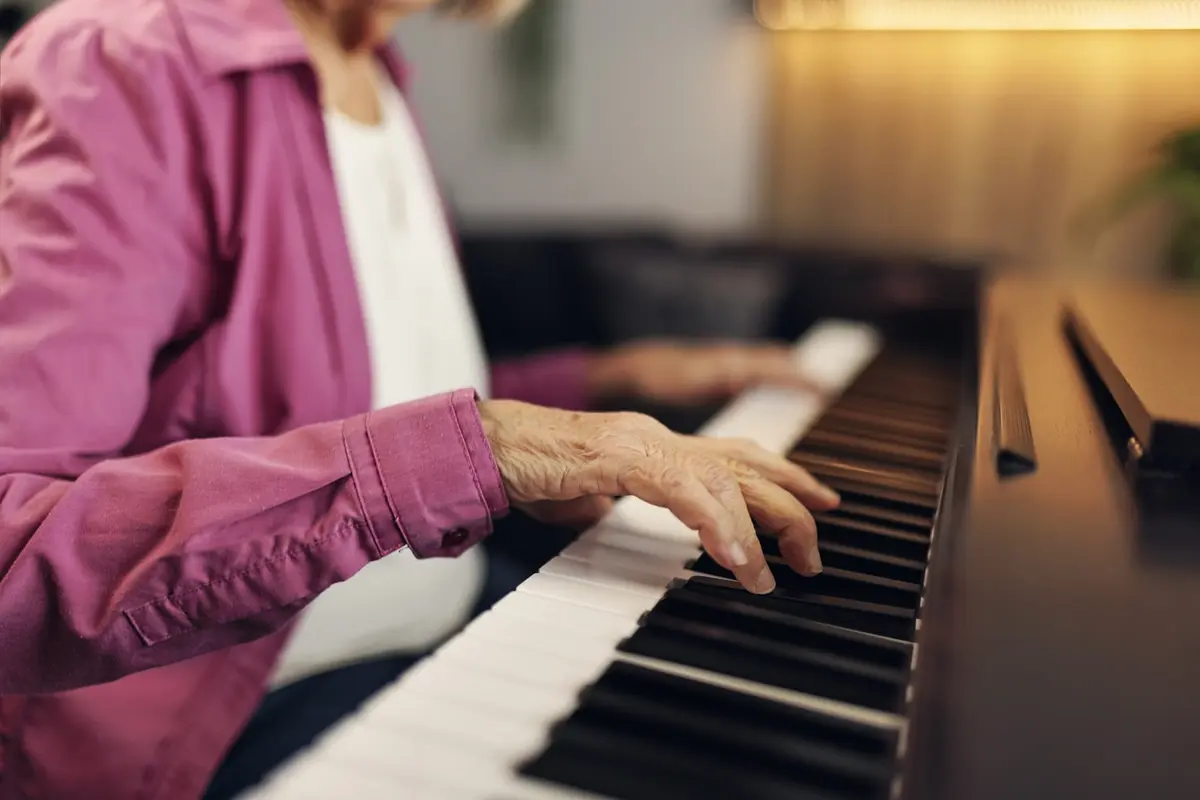
A 2014 study published in Aging & Mental Health found that individual music preference is preserved throughout the process of dementia, and that music is closely linked to personal identity and life history in ways that remain accessible even as other cognitive functions decline. What the research describes, the staff at Madonna Gardens witnessed firsthand when Susan sat down at the piano.
When Susan’s son shared that his mother had played piano for many years, the team saw an opportunity to reconnect her with something meaningful. The Lifestyle Director and Resident Care Director invited Susan to sit at the community piano. She sat down and began to play, moving the Lifestyle Director nearly to tears. Moments like this show how music therapy for dementia can create powerful opportunities for connection, memory, and emotional expression.
What made the moment possible was not simply the presence of a piano. It was the staff’s attention. They listened when Susan’s son described her musical history, recognized what that information could mean for her, and acted on it.
Music does not simply provide entertainment for people with dementia. It gives them back something of who they have always been.
Key Takeaways
- A 2014 study in Aging & Mental Health via PMC found that individual music preference is preserved throughout the process of dementia, that music is closely linked to personal identity and life history, and that the effects of music go beyond behavioral symptom reduction to the preservation of personhood itself.
- The Alzheimer’s Association identifies music as one of the most accessible and beneficial activities for people living with dementia, noting that musical memories are often preserved even in later stages.
- Music reaches parts of the brain that dementia affects later and less severely than others, allowing people who can no longer follow a conversation, recall a name, or recognize a face to respond fully to a song from their past.
- At Madonna Gardens in Salinas, California, live music is part of our activities, a recurring program that brings assisted living and memory care residents together in shared experience weekly.
Why Music Therapy for Dementia Benefits Seniors
Music therapy benefits seniors with dementia through three mechanisms the research distinguishes: immediate sensory engagement accessible at all stages of the disease, preservation of personal identity through musical memory, and social connection when verbal communication has become unreliable. Together these explain why music reaches people that other interventions cannot.
A 2014 qualitative study in Aging & Mental Health via the National Library of Medicine gathered perspectives from people with dementia, their family carers, care home staff, and music therapists. Six key themes emerged. Three are most relevant to memory care practice. First, music provides immediate stimulation that people at all stages of dementia respond to, including those who no longer engage with most other activities. Second, music is closely tied to personal history, cultural identity, and life events in ways that persist even as explicit memory fails. Third, music creates connection between people when words are no longer enough.
The effects of music go beyond the reduction of behavioral and psychological symptoms. Individual music preference is preserved throughout the process of dementia. Sustaining musical and interpersonal connectedness helps value who the person is and maintain their quality of life.
Susan at the piano is not an anecdote. It is evidence.
How Music Preserves Personal Identity in Dementia
For people with dementia, the most profound effect of music is not that it calms them or engages them, though it does both. It is that it shows them, and the people around them, that they are still fully present in the most essential ways. Susan’s musical identity did not disappear when her dementia changed other capacities. It was waiting for an instrument and an invitation.
The research found that musical identity was closely linked to personal history and life events, and that recognition of familiar music was particularly emotionally meaningful for people in later stages of the disease. When a person with dementia plays music they have played for decades, they are not retrieving a fact. They are inhabiting something that belongs to them at a level of the self that dementia reaches last.
Susan’s musical identity did not disappear when dementia changed other capacities. It was waiting for an instrument and an invitation. The act of asking her if she would like to play was the entire intervention. The music did the rest.
The Alzheimer’s Association notes that musical memories are preserved even in dementia’s later stages and that music can shift mood, manage stress-induced agitation, and stimulate positive interaction. What the Susan moment adds to that clinical picture is the human layer: preserved musical identity is not only a symptom to manage. It is a person to recognize.
Our article on Occupational Therapy for Adults with Dementia covers the related research on how purposeful, meaningful activity preserves identity and supports function in people with dementia.
How Live Music in Memory Care Creates Connection Across Care Levels
Live music in memory care creates a specific kind of connection that recorded music cannot fully replicate: shared presence. When a band plays in a common room, residents who might not interact with each other during the rest of the week are experiencing something simultaneously. The music is not background. It is the occasion.
On a recent Friday afternoon at Carefield Madonna Gardens, Bag O Trix performed during happy hour. Mercedes, an assisted living resident, was there. Frances, a memory care resident, was there. Frances crossed the room. She asked Mercedes to dance. They danced. Then they sat together until the afternoon ended.
Frances initiated. Frances chose. This is what the PMC research means when it identifies music’s capacity for creating meaningful connectedness between people. The Friday live music program did not produce that moment through design. It produced the conditions. Frances and Mercedes made the moment themselves.
When verbal connection becomes difficult, music can energize, recognize, elevate, and encourage people, regardless of their level of care. Residents from assisted living and memory care who share very little conversationally can share a song completely. That is what Bag O Trix makes possible every Friday, and what Frances made real on an afternoon that the community will not forget.
Our article on what it means when assisted living and memory care share the same community covers the broader picture of what becomes possible when two levels of care exist in the same building and on the same Friday afternoon.
What Kinds of Music Work Best for People With Dementia
The most effective music for people with dementia is personally meaningful music: songs connected to their specific history, their cultural background, their young adult years, and the life events that shaped them. Research found that individual musical taste is preserved throughout the process of dementia and that recognition of personally significant music produced the most meaningful responses.
This is why gathering a loved one’s musical history is one of the most useful things a family can contribute to a memory care team. What genre. What era. What songs were playing during important life moments. Whether they played an instrument. The son who told the staff about Susan’s years at the piano gave them something more valuable than a care plan note. He gave them a pathway back to who she has always been.
Live music is particularly effective because it is inherently social and unpredictable in a way that recorded playlists are not. A live musician can read the room, return to a song that produced a response, slow down when residents are settling, and lift the energy when they are ready to move. Live music plays at Madonna Gardens because it works, and because the community has made that consistency a commitment rather than an occasion.
For families who want to incorporate music into their visits, our article on Visiting a Loved One in Memory Care: What to Expect covers practical guidance on making visits more meaningful.
Music and Memory Care at Madonna Gardens in Salinas, CA
Madonna Gardens offers memory care and assisted living in Salinas, California, in the Los Olivos neighborhood of South Salinas, where music is a consistent and part of the community calendar, not an occasional event. Local bands performs for residents. The happy hour that the two go together brings people from across both care levels into the same room at the same time.
The community’s approach to programming reflects the same belief that the research confirms: who a person has been does not disappear when dementia changes what they can do. It remains accessible through music, through the smell of food they have always cooked, through the people they have always loved. The job of a memory care community is to find those pathways and keep them open.
Madonna Gardens actively looks for those opportunities in every resident, whether through music or another beloved medium. That is the standard the community holds itself to, and the one that families who choose Madonna Gardens experience in the daily life of their loved one.
Families who are still managing everything at home, who are carrying the daily weight of caregiving alongside the grief of watching someone they love change, often say afterward that they did not realize what they had been holding, until they set it down. When a team that knows Susan can play the piano or lets Frances initiate a new connection takes over the daily work of care, the visits change. The worry does not disappear. But it gets shared. And families often find they get to be a daughter or son again, not a manager of symptoms and schedules.
The team at Madonna Gardens is here to talk through what that shift might look like for your family, at whatever pace feels right. This is not a commitment. It is a conversation.
Frequently Asked Questions
1. Why is music beneficial for people living with dementia?
Research on music and dementia points to three distinct benefits: immediate engagement accessible at every stage of the disease, preservation of personal identity through musical memory, and social connection when verbal communication has become unreliable. Individual music preference is preserved throughout dementia, and music reaches the self in ways that explicit memory cannot. Sustaining musical connectedness helps value who the person is and maintain their quality of life, making it one of the most powerful non-pharmacological tools available in memory care.
2. What are the best music activities for seniors with dementia?
The most effective music activities involve personally meaningful music connected to a resident’s specific history. Live music attendance, singing familiar songs from their era, playing an instrument they have always known, and music combined with movement such as dancing are all well-supported approaches. The specific music matters more than the format: a song from someone’s twenties, a hymn from their religious tradition, or a piece they have performed for decades will reach them more reliably than generically pleasant music. Gathering a loved one’s musical history before implementing music activities significantly increases their effectiveness.
3. Does playing music reduce dementia?
Music does not prevent or reverse dementia. However, regular engagement with music is associated with reduced agitation and anxiety, improved mood, clearer communication and social connection, and the preservation of personal identity through musical memory. Music does not change the underlying progression of dementia but changes what daily life feels like within it, which has significant effects on quality of life for residents and families alike.
4. What kind of music calms dementia patients?
The most effective music for calming a person with dementia is personally meaningful to them. Familiar songs from their young adult years, music connected to their cultural or religious background, and songs associated with significant personal memories tend to produce the most reliable calming response. Tempo and volume matter as well: slower tempos and moderate volumes are generally more effective for calming than upbeat or loud music. Individual preference remains the most important factor, which is why learning each resident’s musical history is central to effective music care.
5. Can music improve memory for people with dementia?
Music does not restore explicit memory lost to dementia. However, hearing familiar music can temporarily activate memories that otherwise appear inaccessible, particularly from the period when that music was most meaningful. Singing a familiar song can prompt a person to recall lyrics they cannot retrieve through direct questioning. These are not permanent improvements, but they are genuine moments of access that music reliably produces, and that matters enormously to the people experiencing those moments and the families witnessing them.