The East Bay has always been one of the most culturally varied regions in California. The residents who call Carefield Castro Valley home bring that same richness with them: different languages, heritages, traditions, and life stories that fill the community with something no amenity checklist can replicate.
A diverse senior living community is one that actively reflects the backgrounds of the people who live there, not just in décor or a single annual event, but in how the day is built. At Carefield Castro Valley, that shows up in the programming, in the dining room, in the clubs, residents have shaped themselves, and in the outings the team plans because residents asked for them.
Why Diverse Senior Living Community Matter?
A diverse community matters because belonging matters. According to the National Institute on Aging, diversity in senior living encompasses cultural background, language, race and ethnicity, gender identity, religion, and more. When residents feel their identity is seen rather than overlooked, the quality of daily life shifts in measurable ways.
A 2024 systematic review in Frontiers in Aging looked at research on diversity among older adults in nursing homes and healthcare centers. It concluded that addressing diversity matters for both mental and physical health as people age.
The Census Bureau’s 2017 population projections show where this is heading. By 2030, one in five Americans is projected to be of retirement age, and the population is projected to grow more racially and ethnically diverse in the years that follow.
At Carefield Castro Valley, that is not a trend to prepare for. It is already reflected in the residents, the staff, and the East Bay community just outside the door.
What Are the Benefits of Equality and Diversity in a Senior Living Community?
The benefits show up in ordinary moments. A game, a meal, a song, a story. When programming reflects residents’ actual backgrounds, a familiar cultural touchpoint becomes a way into the day instead of a reminder of how far from home someone is.
Learning about someone else’s traditions gives residents something to ask each other, and that is often where friendships start. Social connections in assisted living grow from what residents bring to the room, not from what the calendar assigns them.
How Does Cultural Diversity Show Up in Lifestyle Programming?
Cultural diversity shows up in lifestyle programming when activities grow from who is actually in the room.
At Carefield Castro Valley, one of the clearest examples is the Mahjong Club. After residents expressed interest in the centuries-old tile game, a friend of one resident volunteered to teach and play every Monday. The club now meets weekly. Mahjong sharpens memory, builds strategic thinking, and encourages pattern recognition. It also carries cultural weight for residents who grew up with it as part of daily life. A game that originated in China and spread across Asian communities worldwide has found a regular home in Castro Valley because the residents here asked for it.
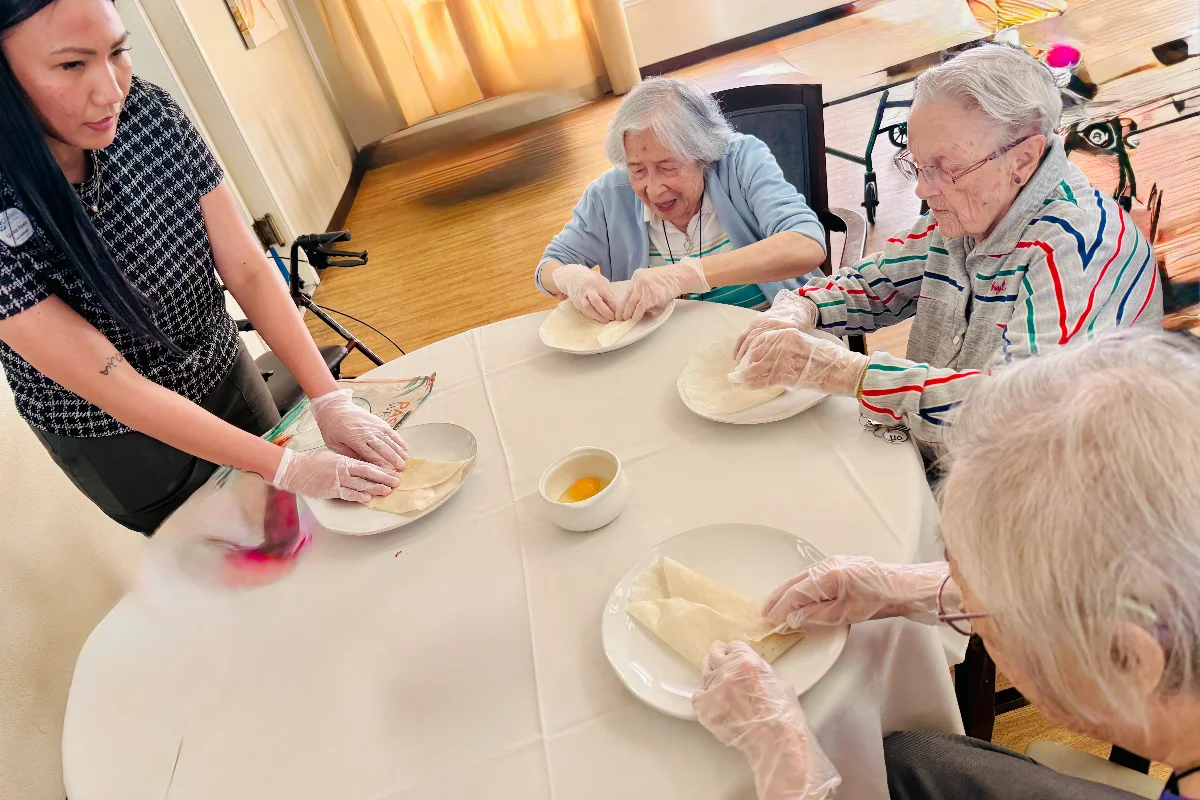
Residents take part in a hands-on cooking activity that brings food traditions, conversation, and shared experiences into community life.
The same attentiveness appears in how the team marks heritage occasions. One staff member taught residents to make Lumpia, Filipino spring rolls, while a different caregiver demonstrated Pancit, a Filipino noodle dish. A Luau brought the same spirit to a larger table, with a buffet that included Kalua pig.
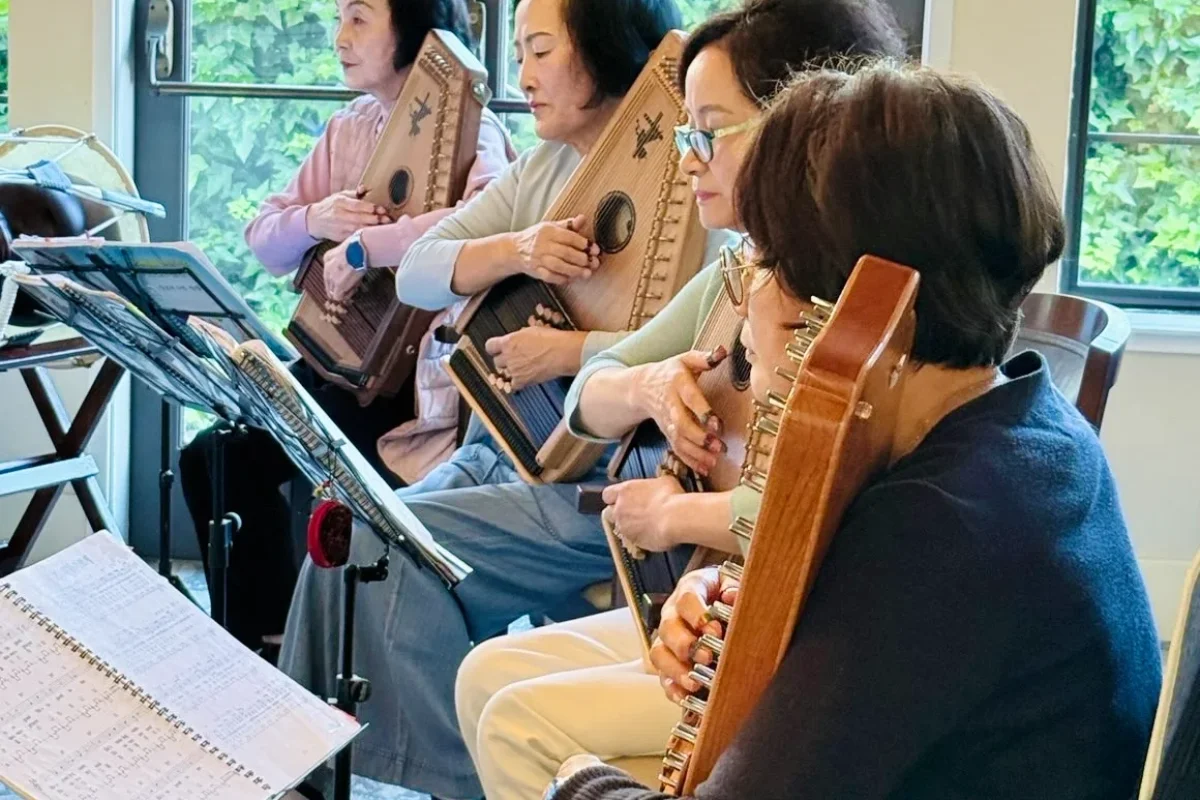
Traditional music performances bring cultural expression, memory, and community connection into resident programming.
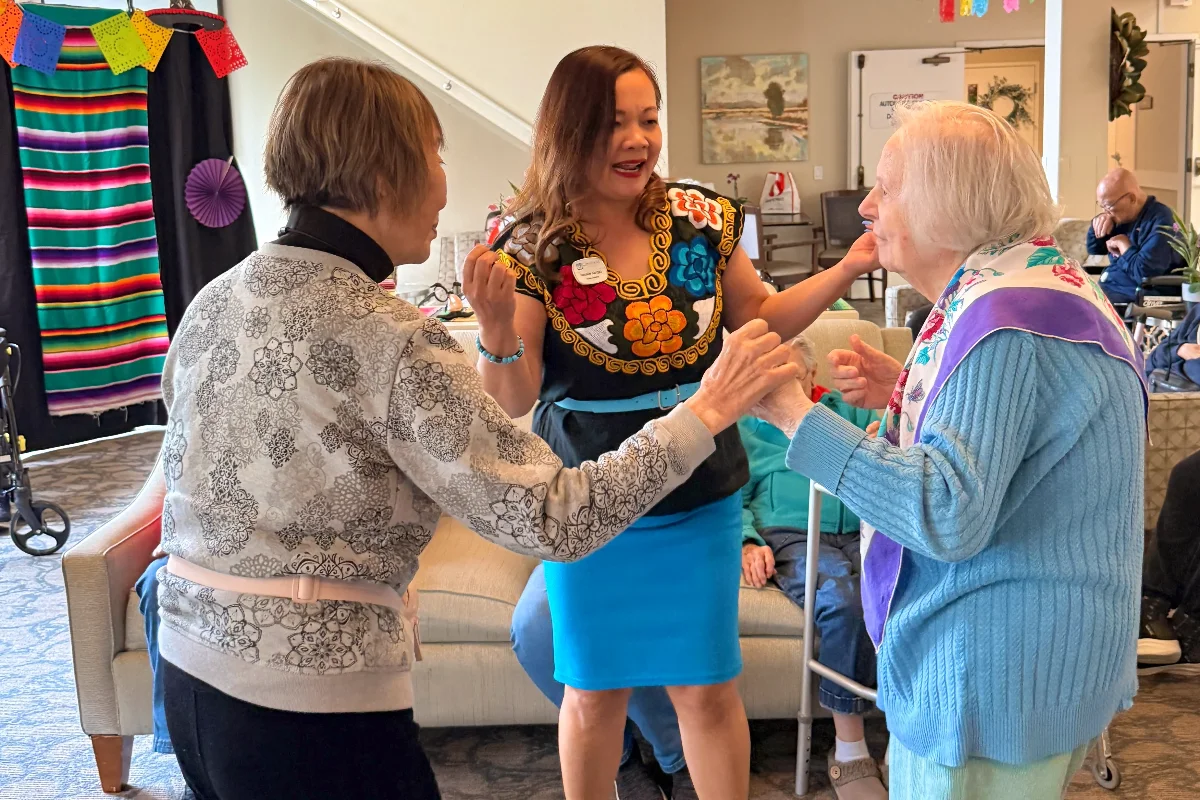
Music and dance come through the door too. Every year, singers and dancers from the Golden Crane Senior Center, a Chinese American volunteer group, perform around Chinese New Year, and a Korean church regularly hosts Songs & Praises. Caregivers dance with residents as well.
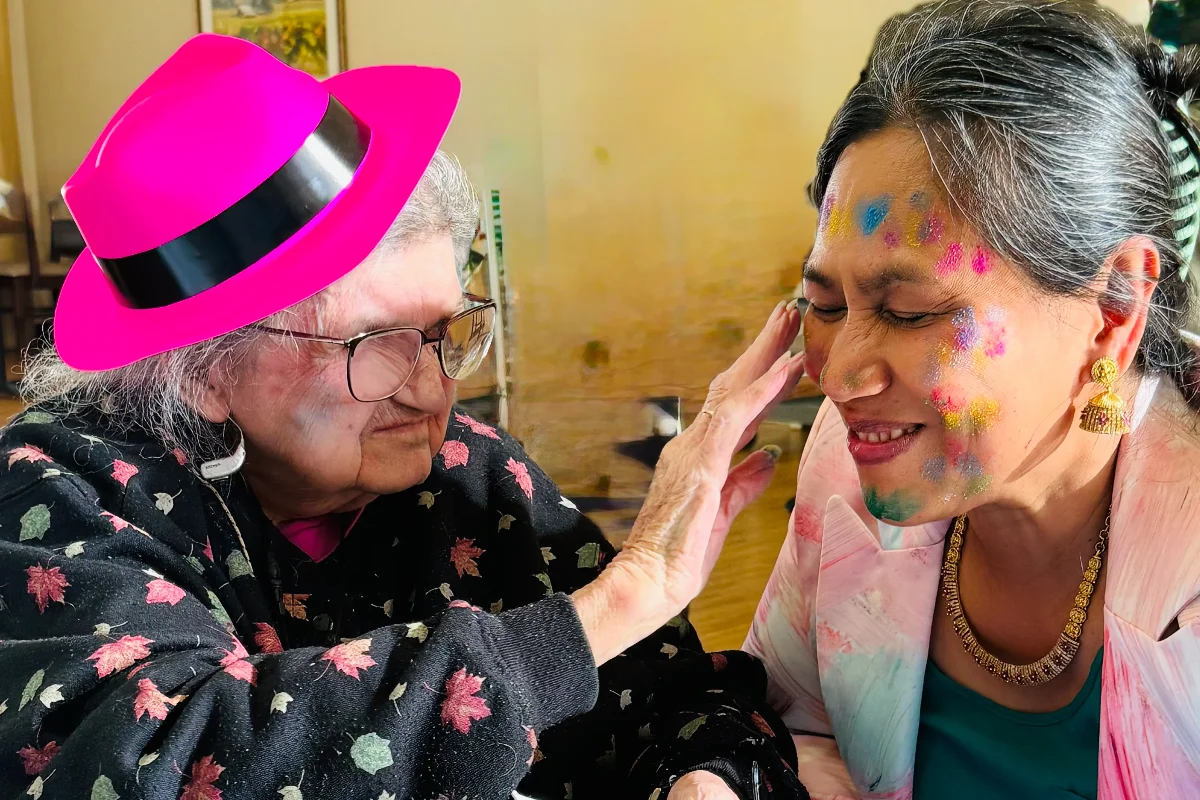
Holi brings residents and team members together through color, cultural traditions, and shared celebration.
Celebrations from around the world also sit on the regular calendar: Mardi Gras and Chinese New Year in February, Holi in March, Cinco de Mayo in May, and the Luau in late summer. After this year’s Chinese New Year, the team wrote that they feel “incredibly fortunate to have such diverse residents and team members.”
Community outings carry this spirit too. The visit to the Castro Valley Veterans Memorial on Memorial Day connected residents, many of whom have served or have family members who served, to a piece of local history that belongs to them. More of how the community builds those connections is covered in daily life and outings at Carefield Castro Valley.
What Are Some Diversity Activities in Senior Living?
The most effective activities in assisted living are ones residents feel personally connected to.
At Carefield Castro Valley, those activities take several forms:
Resident-led programming. Mahjong Club did not originate with the activities team. It originated with residents and continues because a community member steps in to lead it every week. When programming grows from resident interest, participation follows naturally.
Heritage celebrations with staff. The AAPI Heritage Month feast brought staff and residents together at the same table. Staff participated as peers, not as organizers standing at the side.
Community outings. Trips to the Castro Valley Veterans Memorial and Kenneth Aitken Senior Community Center connect residents to the broader East Bay community, diverse, local, and specific to where residents actually live.
Intergenerational exchange. The Silver Fox Club, Carefield Castro Valley’s men’s club, has taken residents out into the community for events like the Hayward Street Party alongside the community’s Memory Care Director and Culinary Director. These outings place residents as active participants in a culturally lively part of the Bay Area.
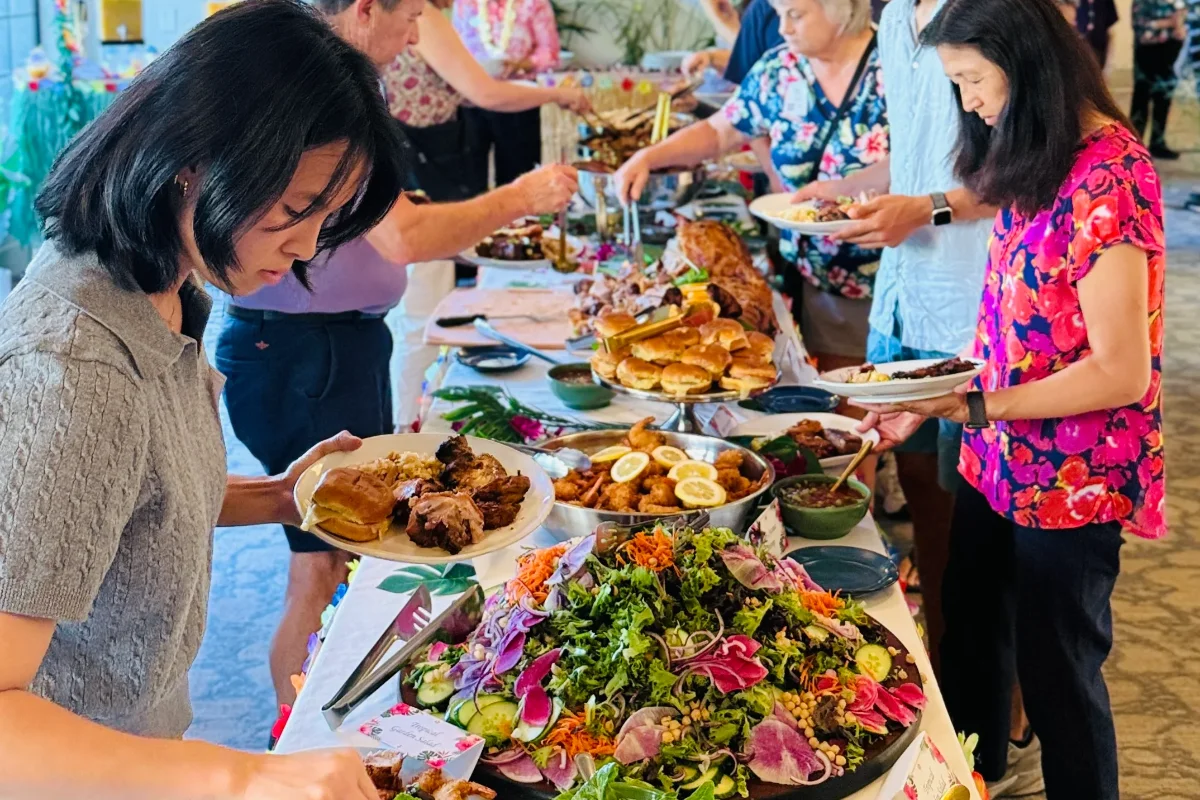
Shared meals and cultural celebrations give residents, families, and team members another way to connect across traditions.
Shared meals. Food is one of the most direct expressions of cultural identity. When special occasions include heritage-inspired menus, residents experience their background not as something to be accommodated but as something worth celebrating.
What Is the Importance of Diversity for Residents’ Families?
Families choosing a senior living community often carry unspoken questions about whether their parent will feel at home. Those questions have a cultural layer that is easy to underestimate.
For families from communities that have historically had limited access to assisted living, the signals a community sends matter. Senior living communities are increasingly working to create environments where residents can participate fully in daily life: through dining menus that reflect residents’ backgrounds, programming that invites residents to share their stories, and inclusive cultures that welcome different perspectives rather than manage them.
What families can look for during a tour is not a diversity statement. It is whether the people in the community reflect people who look like their parents, whether staff speak with cultural familiarity, and whether the activities on the calendar connect to things their parents have actually done. Families researching how assisted living in Castro Valley supports quality of life will find that the community’s approach to programming is part of a broader philosophy, one where daily experience, not just daily care, is the measure of a good fit.
Come See the Community for Yourself
At Carefield Castro Valley, the diversity of our community is something we see and celebrate every day: in the clubs our residents have built, the meals we share, and the outings that connect us to the wider East Bay. If you’d like to experience it in person, we’d love to show you around.
Frequently Asked Questions
What is the definition of a diverse community?
A diverse community is one where people of different cultural backgrounds, ethnicities, languages, belief systems, and life experiences live and participate together. The National Institute on Aging defines diversity in the context of aging to include age, cultural background, cognitive and physical abilities, education, gender identity, language, neurodiversity, race and ethnicity, religion, and sexual orientation. In senior living, a truly diverse community reflects that range in both its residents and its programming.
What are the benefits of diversity for older adults?
Diversity benefits older adults by reducing social isolation, supporting ongoing engagement, and creating a stronger sense of belonging. When residents see their own backgrounds reflected in the community around them, in the activities, the meals, the staff, and their neighbors, daily life feels less like an adjustment and more like a continuation of who they are.
How do you engage seniors in a diverse community?
Engaging seniors in a diverse community means starting with who is actually in the room. Resident-led programming, heritage celebrations where staff participate as peers, and outings with real cultural importance all create engagement that runs deeper than a scheduled activity.
How do you encourage seniors to participate in activities?
Participation increases when activities connect to something meaningful in a resident’s personal or cultural history. Low-barrier options like games, shared meals, and outings to familiar places give residents an easy point of entry.
What are the benefits of equality and diversity in a community?
Equality and diversity in a community benefit everyone living and working there. Research finds that inclusive communities perform better and create environments where well-being and quality of life improve for people of all backgrounds. In senior living specifically, these benefits manifest as stronger social bonds, greater engagement in activities, and a daily sense of being genuinely at home.