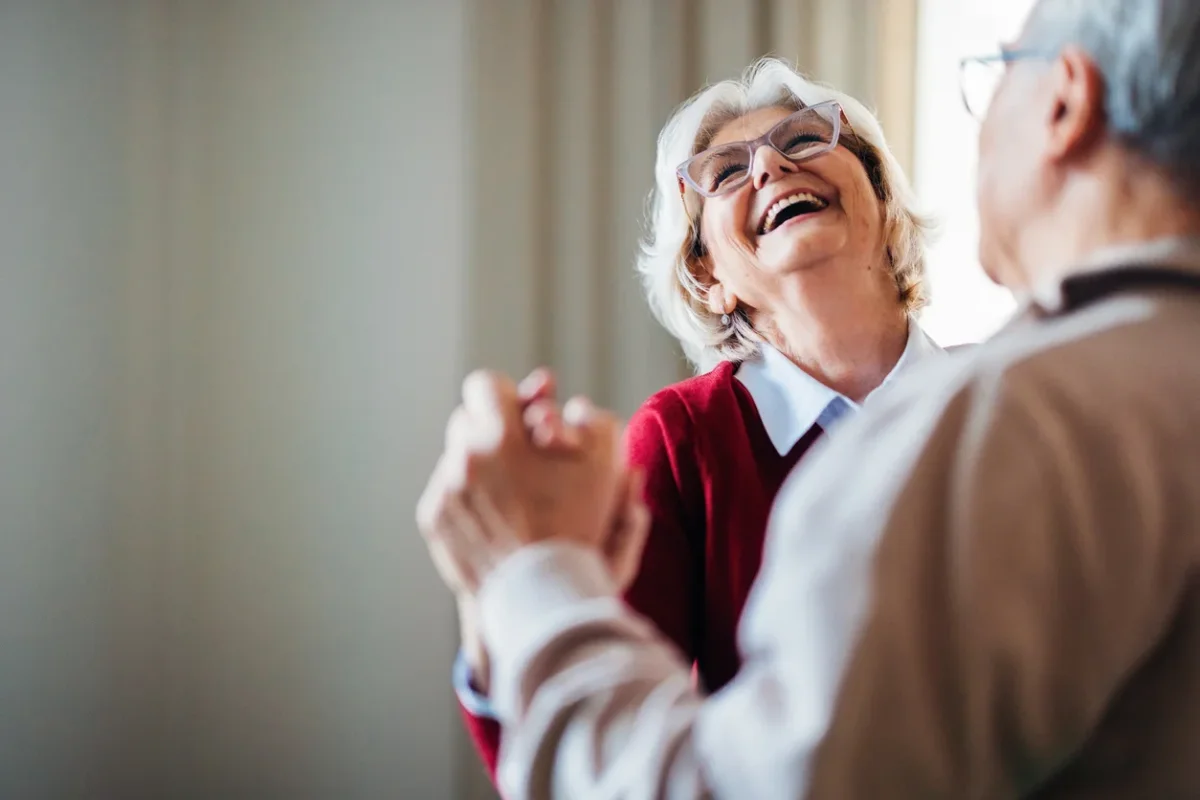
Dancing for seniors is physical, mental, and social all at once. That combination is what makes it different from almost every other activity available to older adults in assisted living and memory care.
At Madonna Gardens in Salinas, CA, that understanding shapes how the lifestyle team programs each week. When a resident named Will started dancing from his wheelchair during Friday Happy Hour, the team did not plan it. Will decided the moment was right. That is the point.
What Makes Dancing Good Exercise for Seniors?
Dancing qualifies as moderate to vigorous physical exercise and works the cardiovascular system, large muscle groups, balance, and coordination simultaneously. Research on dance and physical health shows that dance improves muscular strength, endurance, and balance in older adults, outcomes that support safer, more independent daily living.
Unlike gym exercise, dancing does not feel like a workout. The music carries the movement. Older adults who would resist a fitness class will join a dance session without hesitation, which makes dancing one of the more practical tools for keeping residents consistently active rather than occasionally active.
At Madonna Gardens, movement is built into daily life across both assisted living and memory care, whether standing, sitting, or somewhere in between.
How Does Dancing Benefit the Brain?
Dancing improves cognitive function in older adults by combining physical movement, musical engagement, memory recall, and social interaction into a single activity. The cognitive demand of dance, remembering steps, responding to music, anticipating what comes next, exercises the brain in ways that walking on a treadmill does not.
That dual engagement of body and mind is part of why dance performs consistently well in research on healthy aging. For residents managing mild cognitive impairment or early memory changes, dance offers a low-pressure entry point into structured engagement that supports cognitive health without requiring language or instruction.
Why Dancing Matters for Seniors Living with Dementia
Dancing reaches people with Alzheimer’s disease and dementia through pathways that remain intact even as verbal communication becomes more difficult. Music and movement are processed in parts of the brain that dementia affects later than language and reasoning. A resident who struggles to hold a conversation may still move with ease and pleasure when familiar music begins.
Research on dance and dementia found that dance interventions had a significant effect on global cognition and memory in older adults with mild cognitive impairment, Alzheimer’s disease, and dementia, and significantly reduced depression. At Madonna Gardens, music and movement are not scheduled as separate items in memory care. They inform how staff engage with residents throughout the day.
The Triple-Threat: Why Dancing Does Three Things at Once
“We call dancing a triple-threat activity,” the Madonna Gardens team wrote after watching Will dance during Friday Happy Hour. “Dancing is physical, mental, and social. It combines exercise, engagement, interaction, and self-expression. Will is a testament that you can get all those benefits standing or sitting.”
No other activity on a senior living calendar delivers those three things reliably at the same time. Art is creative but not cardiovascular. Walking is physical but not inherently social or cognitively demanding. Music is mental and emotional but passive. Dancing is all of it, at once, and it asks residents to be present in a way that most activities do not.
That is why the team at Madonna Gardens treats it as more than a scheduled class.
Chair Dancing: Why Accessibility Is Not an Afterthought
Chair dancing makes the full benefits of dance available to residents with limited mobility, balance concerns, or those more comfortable seated. Arm movements, upper body rotation, gentle swaying, and clapping to music all engage the cardiovascular system and support coordination without requiring standing balance.
A 12-month study of older adults found that a weekly dance program produced statistically significant improvements in physical activity and self-rated health, with a 70% adherence rate maintained across the full year. The option to sit or stand was one of the most frequently named reasons participants kept coming back.
Will’s moment at Friday Happy Hour demonstrated exactly this. The team noted that residents can benefit from dancing whether standing or sitting. At Madonna Gardens, the activities team adjusts in real time, which means no resident is watching from the outside when the music starts.
What Dancing Means for Families Choosing Senior Living
Families researching assisted living often think about safety, staffing, and daily care routines. What is harder to evaluate is whether a community creates the conditions for a parent to feel like themselves, not cared for, but alive.
The Madonna Gardens team put it plainly: “Happiness encourages health, which prolongs safety. The bedrock of achieving happiness, health, and safety is human connection.” Dancing is one of the most direct expressions of that connection. It asks nothing of a resident except to be present.
Families exploring assisted living in Salinas, CA will find that the lifestyle philosophy at Madonna Gardens runs through everything on the calendar, not just the events worth posting about.
Come See What Friday Looks Like at Madonna Gardens
At Madonna Gardens, dancing is not a scheduled event that residents attend. Regular live music and a team that encourages dancing set the atmosphere, and when a resident like Will decides it is time, the room follows. If you would like to see that kind of daily life in person, the Madonna Gardens team would be glad to welcome you.
Frequently Asked Questions
Is dancing good exercise for seniors?
Yes. Dancing qualifies as moderate-to-vigorous physical exercise, depending on the style and pace. Research shows that dance improves muscular strength, endurance, and balance in older adults. It also supports cardiovascular health, flexibility, and coordination. Chair dancing delivers comparable benefits for residents who prefer to stay seated. Speak with a healthcare provider before beginning any new movement program.
Is dancing good for dementia patients?
Dancing is particularly effective for people living with dementia because music and movement engage parts of the brain that remain functional even as other cognitive abilities change. Research found that dance interventions had a significant effect on global cognition and memory in older adults with mild cognitive impairment, Alzheimer’s disease, and dementia, and significantly reduced depression. At Madonna Gardens, music and movement are integrated throughout assisted and memory care programming as tools for daily engagement, not just scheduled activities.
Is 30 minutes of dancing good exercise?
Thirty minutes of dancing is a meaningful workout for older adults. The American Heart Association classifies dancing as moderate-to-vigorous physical activity, depending on intensity. Even shorter sessions of 15 to 20 minutes provide cardiovascular, balance, and coordination benefits. At Madonna Gardens, movement occurs in both formal and informal moments throughout the day, so residents benefit from multiple shorter sessions rather than a single block of time.
Is dancing as good as walking?
For older adults, dancing can offer benefits equal to or greater than walking when measured across physical, cognitive, and social outcomes. Walking supports cardiovascular health and lower-body strength. Dancing does those things while simultaneously adding balance training, coordination, cognitive engagement, emotional expression, and social connection. Both are valuable. At Madonna Gardens, both are part of daily life.
What are the benefits of dancing for seniors?
Dancing for seniors improves muscular strength, balance, and endurance; supports cardiovascular health; enhances cognitive function and memory; reduces feelings of loneliness and social isolation; and provides an outlet for emotional expression. Research also shows that dancing significantly reduces depression and improves global cognition in older adults living with mild cognitive impairment and dementia.