
When assisted living and memory care exist within the same community, something happens that neither level of care can produce alone: residents at different points in their journey share daily life, meals, music, and the ordinary moments that make a place feel like home. The benefit is clinical, practical, and human. Most families discover it only after they arrive.
Frances lives in memory care. Mercedes lives in assisted living. One afternoon, Frances walked across the room, reached out her hand, and asked Mercedes to dance. They danced. When the music stopped, they sat together until happy hour .
Nobody scheduled that moment. Nobody designed it. It happened because both women live in the same community, move through the same spaces, and share the same Friday afternoon live music with Bag O Trix.
That is what a community offering both assisted living and memory care makes possible. Not just for residents. For the families watching.
The decision to choose a community that offers both assisted living and memory care is often made for practical reasons. The reason families are glad they made it is almost always something else entirely.
Key Takeaways
- When assisted living and memory care are within the same community, residents at different stages of cognitive and physical change share daily life, programming, and social connection in ways that separate communities cannot.
- The National Institute on Aging identifies social isolation as a significant health risk for older adults, linked to higher rates of cognitive decline, depression, and premature mortality. A community where residents across care levels connect daily addresses that risk structurally.
- Continuity of care within a single community means that if a loved one’s needs change from assisted living to memory care, the caregivers who know them stay the same, the environment stays familiar, and the transition carries far less disruption than a move to a new community.
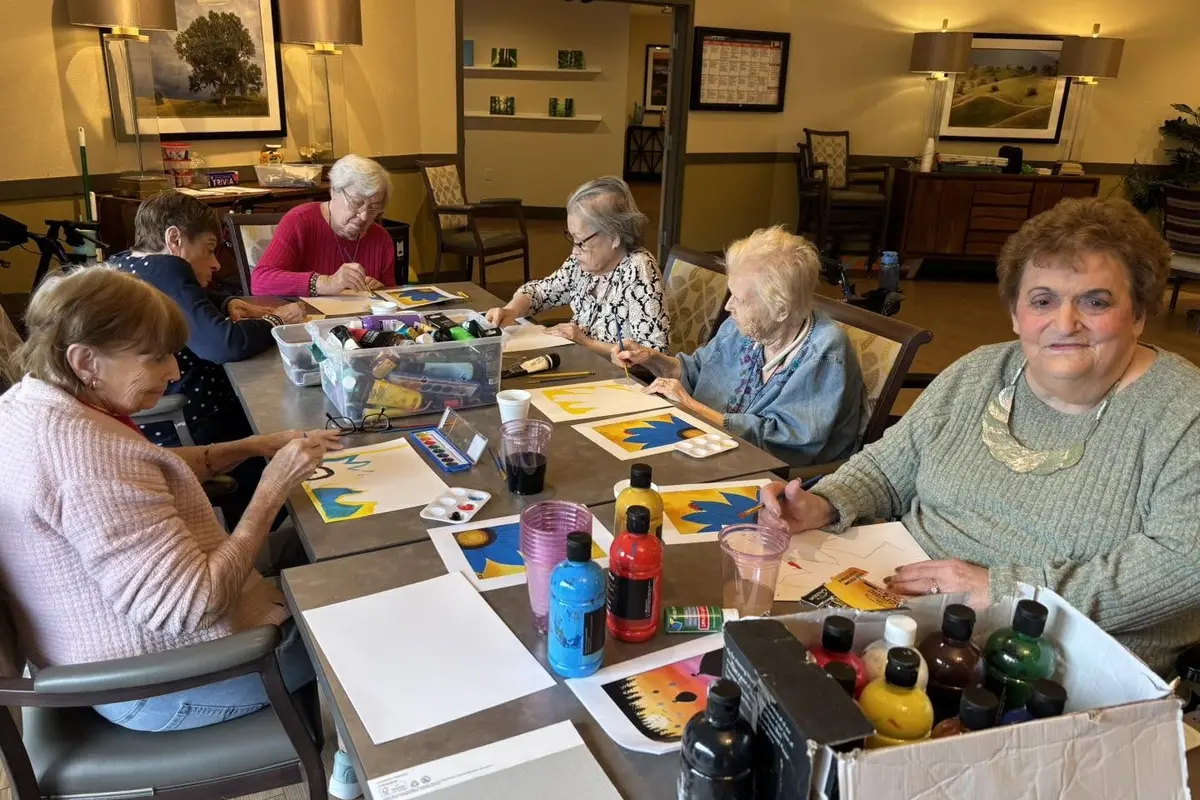
- At Carefield Madonna Gardens, live music sessions with rotating local bands, Sip and Paint sessions, and shared mealtimes regularly bring assisted living and memory care residents together, fostering the kind of spontaneous connection that Frances and Mercedes demonstrated.
Why Assisted Living and Memory Care in the Same Community Changes What Care Actually Looks Like
The most practical benefit of choosing a community that offers both assisted living and memory care is also the most overlooked: when a loved one’s needs change, they do not have to start over. A new community means new caregivers, new routines, new environments, and a new adjustment period at exactly the moment when stability matters most.
When the transition occurs within the same building, the losses typically associated with a move to memory care are minimized. The caregiver who has known your father for eighteen months already knows his habits, his preferences, his difficult hours, and the small things that make a hard moment manageable. That accumulated knowledge does not transfer cleanly through documentation. It lives in the people whoknow them.
Our article on Memory Care vs. Assisted Living covers the specific differences between these two levels of care and how families can understand which is the right fit at any given stage. The question of which to choose and whether those two options should exist under the same roof are related but distinct. Choosing a community that offers both resolves both questions at once.
What Social Connection Looks Like When Both Levels of Care Share a Home
Social connection across care levels in a community that offers both assisted living and memory care yields something neither level of care can provide alone: the experience of being part of a larger community rather than a defined clinical category.
When a Memory Care Resident Walks Up to an Assisted Living Resident and Asks Her to Dance
That moment carries more information about the quality of life available to a memory care resident at Madonna Gardens than any brochure description could. A person whose cognitive capacity has changed enough to require memory care retained enough social instinct, warmth, and presence to reach out to another person and make something happen. The community made the conditions for that possible by placing both women in the same space on the same Friday afternoon .
Live Music That Reaches Everyone Regardless of Care Level
Live music remains a regular part of the calendar at Madonna Gardens, with different bands rotating through. Music is one of the most reliably cross-accessible forms of engagement in a senior living community. It does not require verbal fluency. It does not require physical mobility beyond the capacity to feel rhythm and respond. It reaches residents at different cognitive and physical stages and produces shared experience precisely because it does not demand the same thing from everyone who participates.
When Mercedes and Frances found each other that afternoon, Bag O Trix was playing. The music was the condition. The connection was theirs.
The Programs That Make Connection Possible
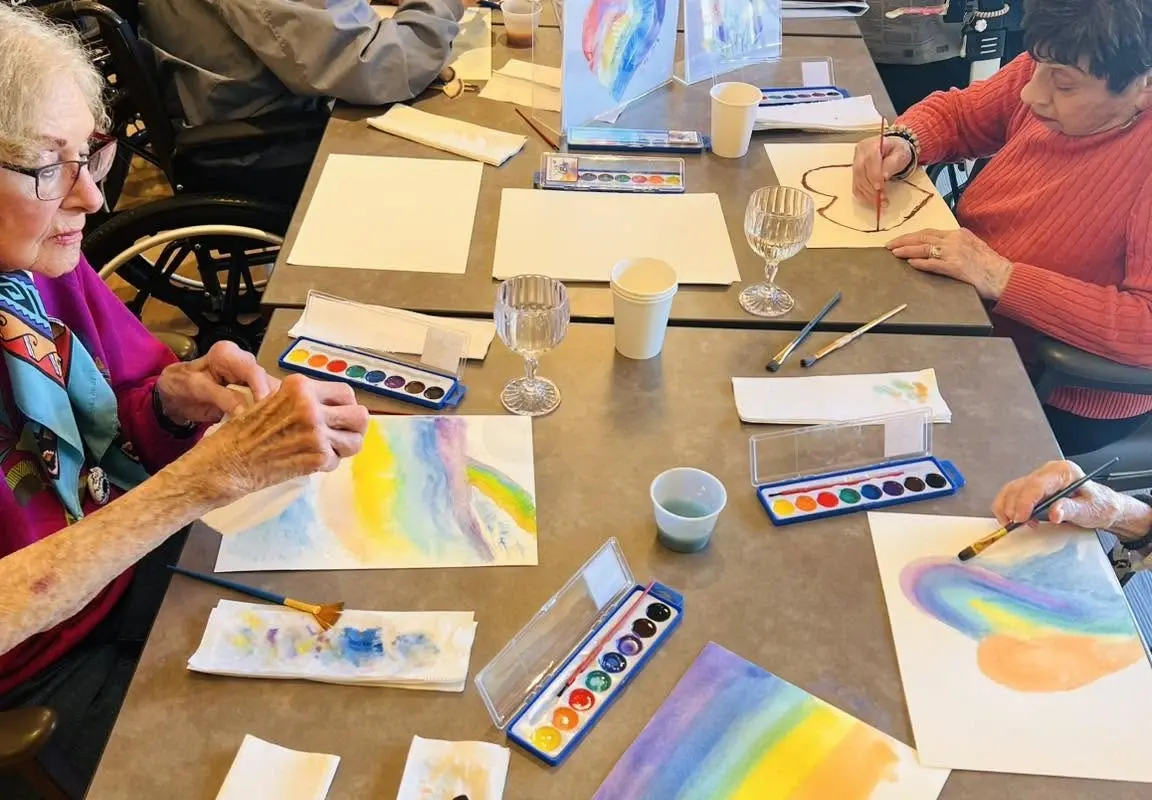
Sip and Paint sessions at Madonna Gardens recently drew a resident who usually prefers to read alone in his room. He joined. That is what the right kind of programming does: it lowers the barrier to participation without removing the choice. A resident who might not join an organized group activity will sometimes join something that feels more like an afternoon than a program.
These sessions, like regular live music, operate across care levels. The shared experience produces the shared conversation. Our article on Visiting a Loved One in Memory Care: What to Expect covers how the quality of daily programming changes what family visits feel like in a memory care community.
How Continuity of Care Protects What Families Have Already Built
When a person with dementia moves between care levels within the same community, the caregivers who know them stay the same — which is one of the most clinically significant protections a community offering both assisted living and memory care can provide.
For families who have already navigated the transition from home care to assisted living, the idea of another move, another adjustment period, another round of introductions to new caregivers, is one of the things they dread most about the possibility of their loved one needing memory care.
A community that offers both makes that second transition meaningfully different. The person who needs more support does not lose the relationships that took months to build. The caregiver who notices when something is off, not because the chart says so but because they know what normal looks like for this specific person, remains in place. The outdoor spaces, the dining room, and the daily rhythm of the building remain familiar. Only the level of support changes.
Our article on Occupational Therapy for Adults with Dementia covers the research on why continuity of environment and familiar routine are clinically important in dementia care, and what communities can do to support that continuity structurally.
What Families Notice When Both Levels of Care Share the Same Building
Families who visit a loved one at Madonna Gardens often notice something they did not expect: the community is larger than the person they came to see.
For families whose loved one is in memory care, this matters in a specific way. Visiting a standalone memory care community means moving through a space designed entirely around cognitive impairment. Every surface, every program, every interaction is filtered through that lens. Visiting a community that also offers assisted living means being in a place where different kinds of life are happening simultaneously. That broader context changes what the visit feels like, for the family and sometimes for the resident.
Some families have a loved one in assisted living and are just beginning to wonder what happens if needs change. For them, being in a community where memory care is present but not prominent means something too. They can see what that level of care looks like in a real environment, not through a brochure, and assess whether it is a community they would want for their family member if that day comes.
Our article on the outdoor spaces in assisted and memory care at Madonna Gardens covers how the shared outdoor environments at Madonna Gardens, the garden courtyard with its gazebo and walking path, the sunny patios opening from both dining rooms, and the large memory care yard, create natural spaces for this broader community life to unfold.

Assisted Living and Memory Care at Carefield Madonna Gardens in Salinas, CA
Carefield Madonna Gardens offers assisted living and memory care within the same community in the Los Olivos neighborhood of South Salinas, California, on a seven-acre property that was once Madonna Manor, an all-female community run by The Catholic Daughters of America. The stained glass windows from the original building have been repurposed into a tranquil reflection circle in the garden courtyard, giving the space a particular stillness that residents return to.
Salinas’s mild Mediterranean climate, moderated by the proximity of Monterey Bay, supports year-round use of the outdoor spaces that connect assisted living and memory care residents to the natural environment and to each other.
If you are trying to understand whether assisted living or memory care is the right fit right now, our article on Signs It Might Be Time for Assisted Living and our article on How to Choose the Right Assisted Living Community in Salinas cover the specific questions families are usually working through at this stage.
Choosing professional care for a loved one when home caregiving has reached its limits is a responsible decision, not a failure. Communities like Madonna Gardens offer staffing, training, outdoor environments, and programming that no single family member can replicate alone. At Madonna Gardens, families notice the relief most in moments like Frances and Mercedes finding each other on a Friday afternoon: watching a parent still make a friend, still reach for a dance, still be a person rather than a diagnosis. That kind of moment is easier to find in a community built for it. The team at Madonna Gardens welcomes families at every stage of this conversation, and the best way to understand daily life here is to come see a Friday afternoon for yourself.
Frequently Asked Questions
1. What is the benefit of choosing a community that offers both assisted living and memory care?
The primary benefit is care continuity. When a loved one’s needs change from assisted living to memory care, a community that offers both allows them to remain in the same building, with the same caregivers, in a familiar environment. This matters clinically because people with dementia rely on familiarity to feel safe, and transitions to new environments trigger adjustment periods that are harder to navigate as cognitive function declines. It also matters practically: families do not have to restart the process of evaluating, selecting, and transitioning to a new community at an already difficult time.
2. Can assisted living and memory care residents interact in the same community?
Yes, and the social connection that results is one of the most meaningful benefits of choosing a community that offers both. At Madonna Gardens, assisted living and memory care residents can share programming, outdoor spaces, and events. Regular live music sessions, the Sip and Paint sessions, and the shared dining environments all create regular opportunities for connection across care levels. That connection produces the kind of spontaneous relationship that Frances and Mercedes formed: a memory care resident initiating a dance with an assisted living resident, then sitting together until the music ended.
3. How does memory care at Madonna Gardens differ from assisted living?
Assisted living at Madonna Gardens provides support with daily activities, medication management, meals, and personal care within an environment that supports independence and social engagement. Memory care at Madonna Gardens provides all of those things within a more specifically designed and secured environment, with programming adapted to the particular challenges of dementia and staff trained specifically in dementia care. The distinction between the two is covered in detail in our article on Memory Care vs. Assisted Living.
4. What happens if my loved one moves from assisted living to memory care at Madonna Gardens?
If a resident’s needs change, the transition from assisted living to memory care at Madonna Gardens happens within the same community. The caregivers who already know the resident, the outdoor spaces, and the people they recognize all remain part of daily life, even as the resident moves to a room on the memory care side and spends more time in that part of the community. This continuity is one of the most significant clinical advantages of a community that offers both levels of care, and one of the most important questions families should ask when evaluating any senior living option.
5. How does social programming at Madonna Gardens support residents across both assisted living and memory care?
The programming at Madonna Gardens is designed to be accessible across care levels. Live music brings assisted living and memory care residents into a shared experience simultaneously. Sip and Paint sessions draw residents who would otherwise spend the afternoon alone. Shared mealtimes and outdoor spaces create natural conditions for connection without requiring it. The result is a community where residents at different stages of their journey interact as neighbors, not as categories, which is what made it possible for Frances to walk across the room and ask Mercedes to dance.