
Outdoor spaces in assisted living and memory care communities directly affect behavioral symptoms, sleep quality, mood, and daily quality of life for residents. Research consistently links nature access to measurable reductions in agitation and anxiety. But not all outdoor spaces are designed to deliver those benefits. The difference between decoration and therapy lies in whether a resident can actively use the space, every day, as part of their ordinary life.
Most families touring assisted living and memory care communities evaluate the rooms, the dining space, and the activities calendar. Outdoor spaces are typically last on the list.
They are frequently the most important feature to evaluate carefully.
Summer makes this visible in a way no other season does. When patios open, walking paths fill every morning, and garden courtyards become the natural gathering point of the day, you can see exactly what a community has chosen to build.
What a community builds outside reveals what it believes care actually requires.
Key Takeaways
- A 2022 peer-reviewed study in Health and Place via PubMed found that regular outdoor access in memory care communities produced measurable improvements in activity participation, social connection, mood, agitation, light exposure, and sleep among people with dementia.
- Research on Attention Restoration Theory, including a study published in Psychological Science via PMC, found that interacting with nature improves directed attention, working memory, and cognitive functioning, supporting the residual cognitive capacities that dementia has not fully impaired.
- The Alzheimer’s Association Daily Care Plan identifies structured outdoor routines among the most effective non-pharmacological strategies for reducing agitation and supporting daily function in dementia.
- Not all outdoor spaces in assisted and memory care communities deliver clinical benefits. The design determines the outcome: a locked courtyard viewed through a glass door is not the same as a garden courtyard that many residents step directly into from their own rooms.
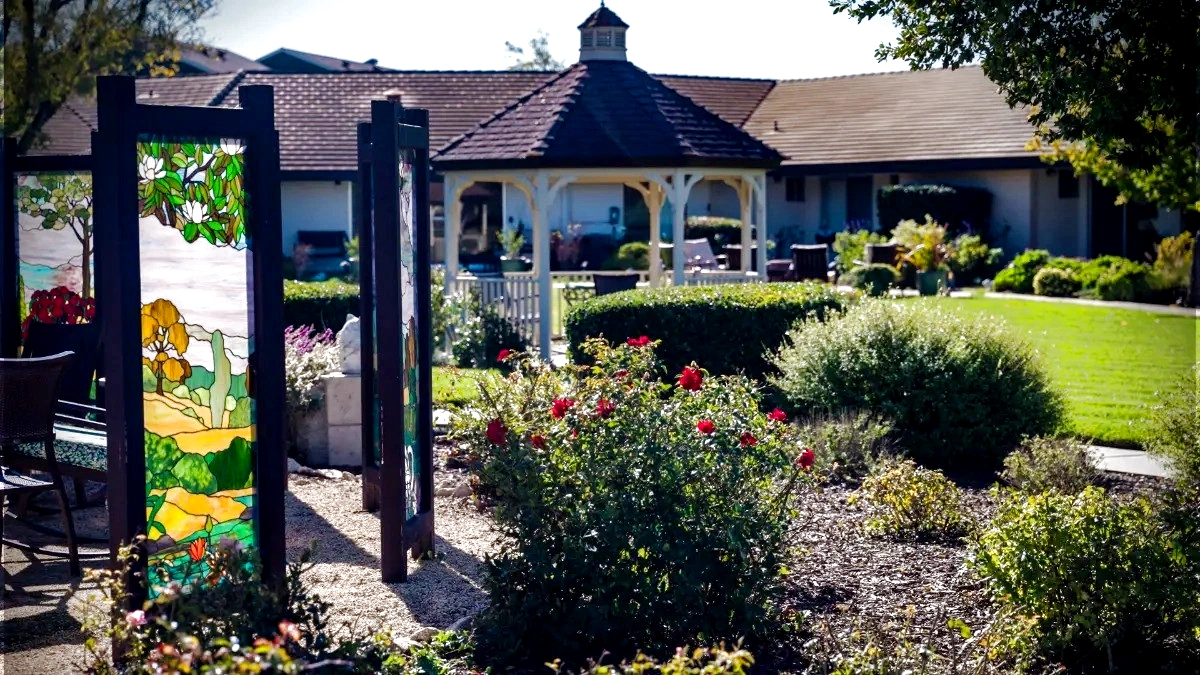
- Madonna Gardens in Salinas offers an expansive assisted living garden courtyard with a gazebo and circular walking path, sunny patios for both assisted living and memory care accessed from the dining rooms, and a large open yard on the memory care side where activities are held throughout the year.
Why Outdoor Spaces in Assisted Living and Memory Care Communities Affect Clinical Outcomes
Access to outdoor spaces in assisted living and memory care is not a lifestyle amenity. It is a therapeutic intervention with documented clinical effects on four of the most significant challenges in dementia care: mood and agitation, sleep quality, cognitive attention, and physical health. A 2022 peer-reviewed study in Health and Place via the National Library of Medicine found that residents with regular outdoor access showed meaningful improvements in activity participation, social connection, mood, agitation, light exposure, and sleep compared to those with limited or no outdoor access.
Mood, Agitation, and Behavioral Symptoms
Natural environments reduce cortisol levels and activate the parasympathetic nervous system, producing a measurable calming effect on the anxious and agitated brain. For residents with dementia who experience restlessness, repetitive behaviors, or late-afternoon agitation, time in a secure outdoor space, hearing birdsong, feeling the sun, touching soil or plants, can interrupt a behavioral cycle in ways that indoor redirection cannot always.
Cognitive Attention and Memory
Research grounded in Attention Restoration Theory demonstrates that interacting with nature replenishes depleted attentional resources and improves directed attention and working memory. A study in Psychological Science via PMC found that walking in nature or viewing natural environments improved short-term memory and cognitive functioning in participants with impaired mood and attention. For people with dementia, whose attentional resources are already diminished, this restorative effect of outdoor environments supports the cognitive capacities that remain, rather than simply slowing the decline of those that are lost.
Sleep Quality and Sundowning
Natural light regulates circadian rhythms, which directly affect sleep quality and sundowning: the increase in agitation and confusion many dementia residents experience in the late afternoon and early evening. Consistent outdoor exposure during daylight hours is one of the most reliable non-pharmacological interventions for reducing sundowning severity. Communities that build morning outdoor time into the daily routine are addressing sundowning at the biological level before symptoms appear.
Physical Health and Cardiovascular Function
Walking, even at a gentle pace through a courtyard or garden path, supports cardiovascular health, joint mobility, and physical strength in older adults. The National Institute on Aging notes that physical activity is among the most effective interventions for maintaining health in older adults with cognitive decline. A community that provides safe, daily outdoor walking access supports physical health alongside behavioral well-being.
The Alzheimer’s Association Daily Care Plan identifies structured outdoor activity routines among the most effective strategies for reducing agitation and supporting daily function in people with dementia. Our article on Occupational Therapy for Adults with Dementia covers the parallel research on purposeful physical engagement and its measurable effects on cognitive and behavioral function.
What Separates Therapeutic Outdoor Spaces from Decorative Ones
When evaluating outdoor spaces in assisted and memory care communities, the key question is not whether a patio exists. It is whether it is designed for genuine daily use by residents across varying levels of mobility and cognitive change. The features below distinguish communities with outdoor spaces from those where residents actually benefit from them every day:
| Feature | Therapeutic Design | Decorative Design |
| Access | Residents step outside directly from rooms or dining room | Outdoor space requires a separate trip or staff escort |
| Pathway design | Looped circular paths that return to a starting point | Dead-end paths that create confusion and disorientation |
| Scale | Spacious enough for activities, walking, and quiet time simultaneously | A small patio primarily designed for visual appeal |
| Daily integration | Outdoor time built into daily routine, meals, and programming | Outdoor access available only during scheduled group outings |
| Active engagement | Garden spaces used for activities, movement, and seasonal programming | Benches for sitting and observation only |
| Safety design | Secured perimeter that feels open and navigable | Locked area that restricts movement and feels confining |
| Summer management | Shade structures, hydration, indoor-outdoor flow built into daily schedule | Outdoor access reduced in summer due to unmanaged heat exposure |
Safe and Secured Without Feeling Confining
A resident who wanders unsupervised is at genuine risk. The secured perimeter is non-negotiable. What the design of that perimeter determines is whether the outdoor space feels like freedom or a restricted zone.
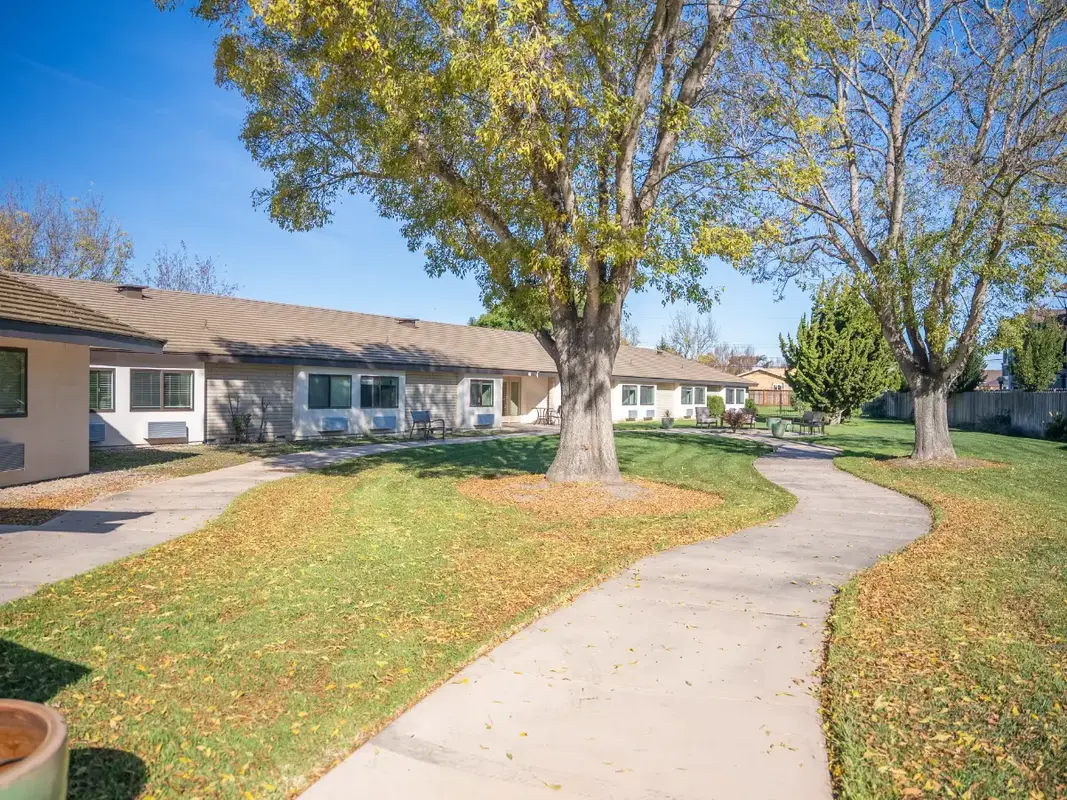
Looped pathways that return to a starting point eliminate the dead ends that produce confusion and agitation. Familiar landmarks, shaded rest areas, and natural wayfinding cues allow residents to navigate with confidence. A well-designed secured outdoor space communicates safety without communicating confinement.
Connected to the Daily Routine
A patio that requires a staff escort to access is used occasionally. A patio that opens directly from the dining room becomes part of everyday life. When the dining room connects to outdoor space, natural light and fresh air become part of the mealtime experience. Residents move between indoor and outdoor environments naturally rather than as a scheduled event.
Designed for Sensory Engagement
Fragrant plantings, textured surfaces, birdsong, the feel of a morning breeze, and the visual variety of a living garden engage the senses in ways that activate present-moment attention and reduce anxiety in people with dementia. Sensory engagement in outdoor spaces is not incidental. It is one of the primary therapeutic mechanisms through which outdoor access produces clinical benefit.
Our article on Memory Care vs. Assisted Living covers the broader design differences between purpose-built memory care environments and general assisted living settings, including how spatial design shapes daily resident experience.
How Summer Reveals the Quality of Outdoor Spaces in Assisted Living and Memory Care
Summer is the season when the quality of outdoor spaces in assisted living and memory care communities becomes most visible and most consequential. When temperatures rise and natural light peaks, the difference between thoughtfully designed outdoor access and decorative outdoor access is felt every day.
For residents with dementia, summer brings both clinical opportunity and specific risk. Natural light exposure supports circadian rhythm regulation and sleep quality at the time of year when light is most available. Familiar summer sensory experiences, the smell of a garden in the morning, the warmth of the sun on skin, the sound of birds, activate emotional memories that other environments cannot reach.
The risk is heat. Residents with dementia are at elevated risk for dehydration and heat-related illness because cognitive decline impairs the reliable recognition of thirst and physical discomfort. The National Institute on Aging identifies older adults with cognitive impairment among the highest-risk groups for summer heat illness.
A community with well-designed outdoor spaces manages this structurally: shaded seating, covered areas, dining rooms that create indoor-outdoor airflow, hydration available throughout the day, and outdoor programming scheduled during cooler hours. A community that manages heat risk by restricting outdoor access is solving the problem by eliminating the benefit.
Summer is the most revealing time to evaluate a community’s outdoor commitment. Ask to see the garden at 9 a.m. on a Tuesday in July.
Outdoor Spaces at Madonna Gardens in Salinas
Madonna Gardens offers outdoor spaces across both assisted living and memory care that are genuinely part of daily life, not reserved for tours or special occasions. The community’s outdoor design reflects a specific commitment to residents of all care levels.
The Assisted Living Garden Courtyard
The assisted living community at Madonna Gardens opens onto an expansive garden courtyard that most families do not expect to find at a senior living community. A circular walking path runs through it. A gazebo sits at its center. The stained glass windows rescued from the original Madonna Manor building, repurposed into a tranquil reflection circle, give the space a history and a stillness that residents return to again and again. Many assisted living rooms open directly onto this courtyard, meaning outdoor access for those residents is as simple as stepping outside their own door.
The Assisted Living and Memory Care Patios
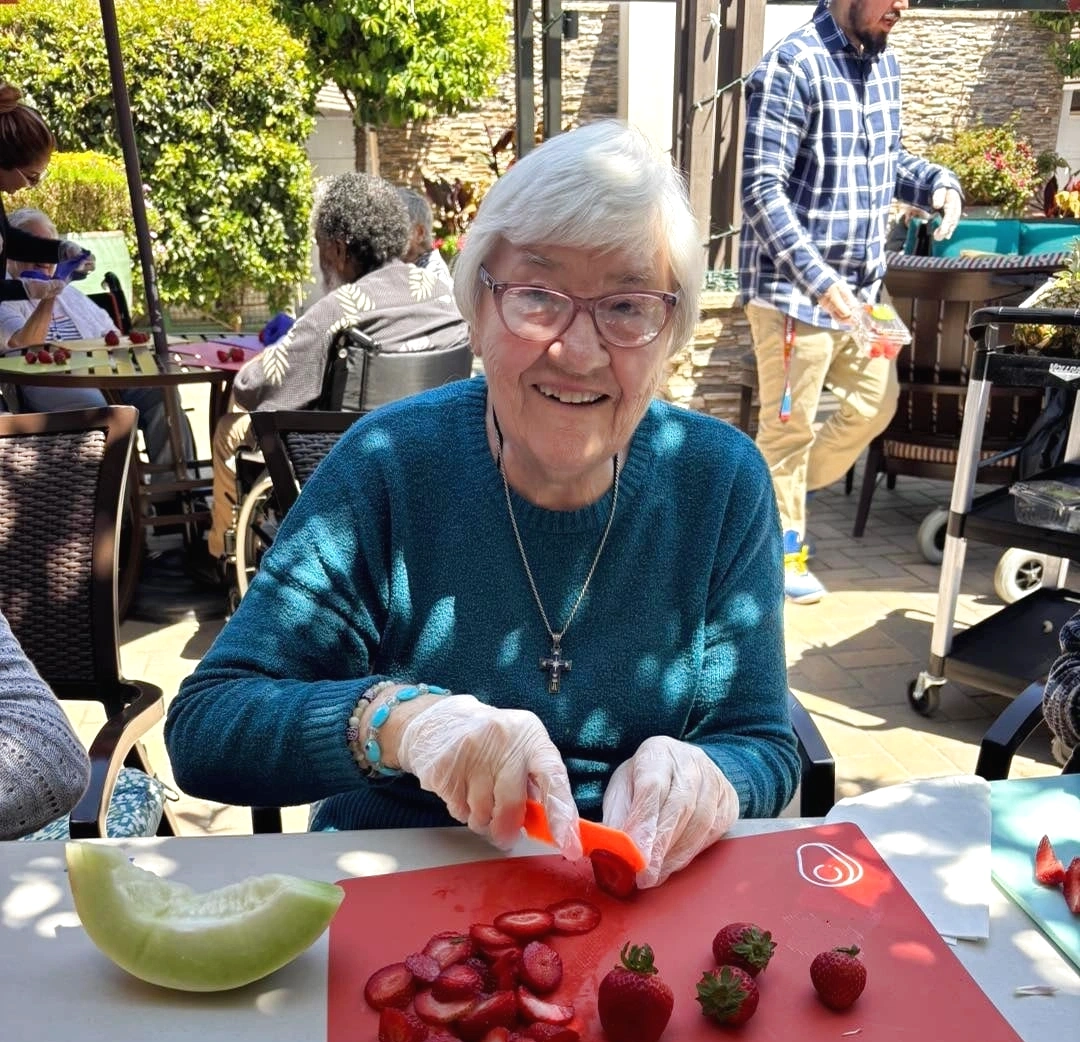
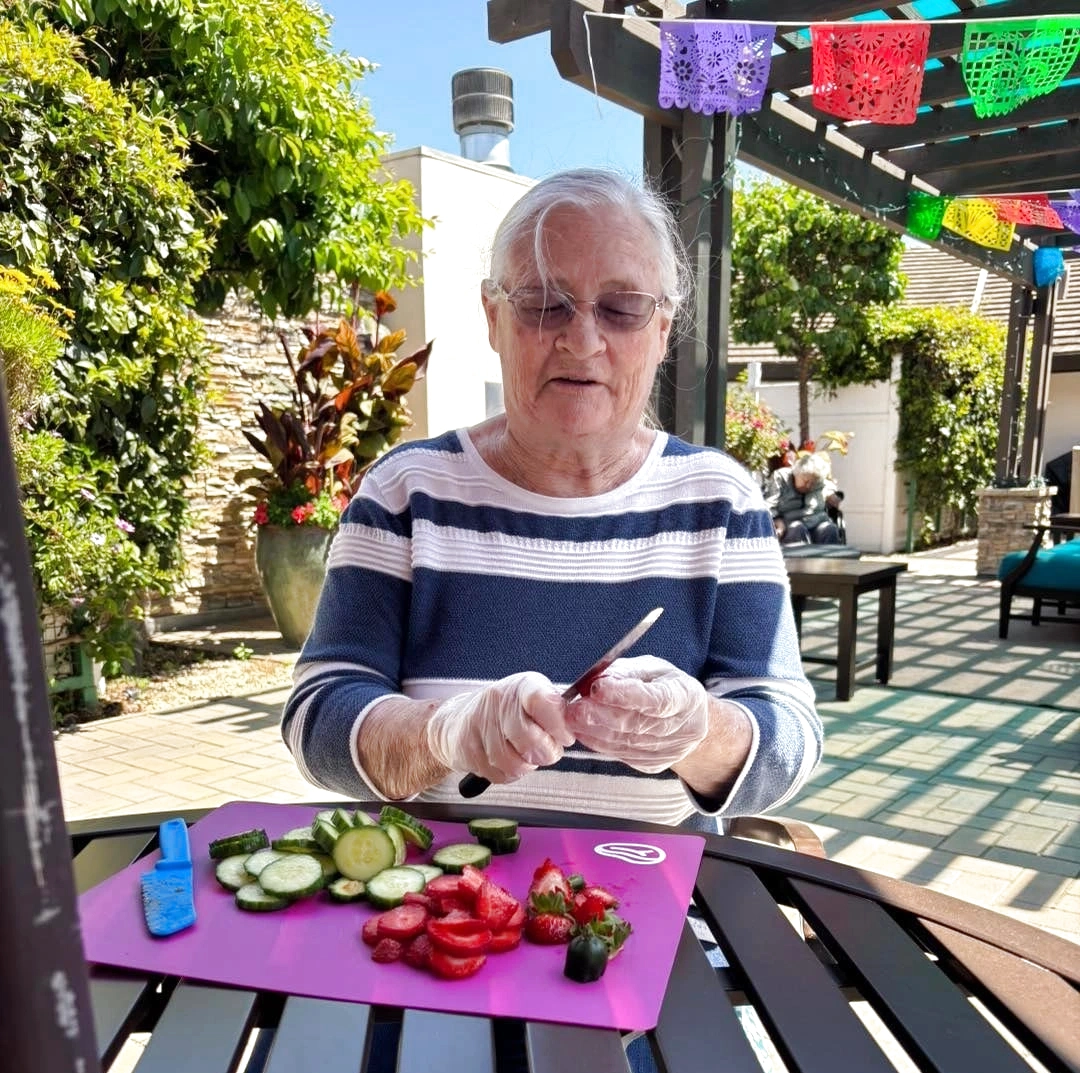
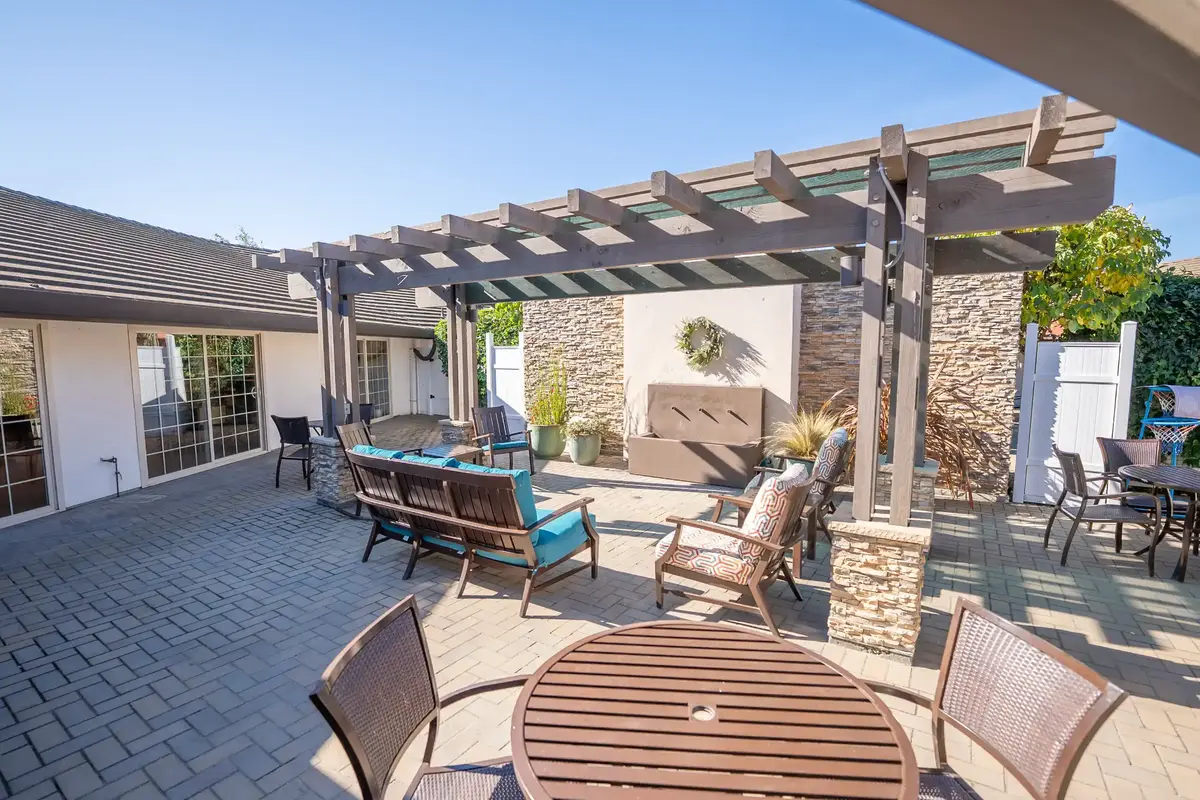
Both the assisted living and memory care dining rooms at Madonna Gardens open directly to their respective sunny patios. Trees and potted plants frame both spaces. The assisted living patio is spacious, with shaded seating, outdoor furniture, and room for meals to extend naturally outside. The memory care patio is similar in character, slightly smaller, and connected to the dining room in the same way. For both, outdoor time is part of the mealtime experience, not a scheduled outing requiring separate coordination.
The Memory Care Yard
The memory care community at Madonna Gardens also has access to a large open yard: expansive, tree-shaded, with paths running through it and enough space for activities to be held entirely outside. It is the kind of outdoor environment that changes what a summer afternoon in memory care can feel like. The yard’s openness and scale give it a different quality from the patio: quieter, more generous, closer to the feeling of simply being outside in the world.
Salinas’s Climate Advantage for Year-Round Outdoor Living
Madonna Gardens sits in the Los Olivos neighborhood of South Salinas, in California’s Central Coast region. Salinas’s Mediterranean climate, moderated by the proximity of Monterey Bay, produces mild year-round temperatures that make outdoor spaces usable in every season. The outdoor access at Madonna Gardens is not a summer amenity. It is a daily environment available to residents 365 days a year.
Madonna Gardens has been recognized by U.S. News and World Report among the Best in Senior Living and as a Great Place to Work, ratings based on resident, family, and staff satisfaction data that reflect the quality of daily life here.
What Good Outdoor Access Means for the Family Experience
When a community has outdoor spaces designed for daily use, family visits look meaningfully different. The setting changes what the relationship can be.
A family member who arrives to find their parent walking the courtyard path, sitting on a sunny patio after lunch, or settled in the yard during an afternoon activity, is experiencing something most families did not anticipate finding in memory care. Instead of sitting across a table in a common room, the visit happens outside. Instead of watching a structured activity, you share a quiet hour in a garden.
The conversation that happens outdoors, surrounded by something living, feels different from the conversation that happens under fluorescent light. Families describe this shift without using clinical language. They say visits feel lighter. More like the relationship they had before dementia made everything harder. They got to be the daughter or son again, not just a caregiver managing a situation.
Our article on Visiting a Loved One in Memory Care: What to Expect covers what families typically experience during visits and how to make the most of them.
Choosing professional memory care for a loved one when home caregiving has reached its limits is a responsible decision, not a failure. Communities built around memory care have staffing, training, and outdoor environments that one family caregiver cannot replicate. Families who make this decision before a crisis always say they wish they had done it sooner. Once they have found real support for their loved one and for themselves, the worry does not disappear entirely, but it no longer has to be carried alone.
The team at Madonna Gardens welcomes families who want to see the outdoor spaces before they make their decision. A summer visit is the clearest way to understand what outdoor life at Madonna Gardens actually looks like.
Frequently Asked Questions
Why are outdoor spaces important in assisted living and memory care communities?
Outdoor spaces in assisted living and memory care communities directly affect four key health domains for people with dementia: mood and agitation, cognitive attention, sleep quality, and physical health. A 2022 peer-reviewed study published in ResearchGate found that regular outdoor access produced measurable improvements in activity-participation, mood, agitation, sleep, and social connection in dementia residents. Research on Attention Restoration Theory also shows that interacting with nature replenishes attentional resources and supports the working memory capacities that dementia progressively impairs.
Does spending time outdoors improve memory for seniors with dementia?
Outdoor time supports the cognitive capacities that remain rather than restoring those that dementia has impaired. Research published in Psychological Science via PMC found that interacting with nature improved directed attention, short-term memory, and cognitive functioning by replenishing depleted attentional resources. For seniors with dementia, whose attentional resources are already diminished, outdoor environments provide a restorative effect on the cognitive capacities they retain. Regular outdoor access also supports sleep quality, which has a direct impact on daily cognitive function.
What makes an outdoor space in memory care dementia-friendly?
A dementia-friendly outdoor space is secured without feeling confining, accessible throughout the day, and designed for active engagement rather than passive observation. Key features include looped pathways that return to a starting point, shaded and covered seating areas, direct connection to dining rooms and common areas so outdoor access is part of daily routine, and enough scale for activities to be held outside. Communities where the dining room opens to the patio make outdoor time a natural part of every day rather than a scheduled event.
How does outdoor access help with sundowning in dementia?
Sundowning, the increase in agitation, confusion, and behavioral symptoms that many dementia residents experience in the late afternoon and evening, is significantly affected by circadian rhythm disruption. Regular daytime natural light exposure is one of the most reliable non-pharmacological interventions for regulating circadian rhythms and reducing sundowning severity. Communities that build outdoor time into the daily morning and early afternoon routine are addressing sundowning at the biological level rather than managing it only with behavioral interventions after symptoms appear.
Are outdoor spaces safe for dementia residents in summer heat?
Yes, when properly designed. The National Institute on Aging identifies older adults with cognitive impairment among the highest-risk groups for heat-related illness because dementia impairs the reliable recognition of thirst and physical discomfort. Well-designed communities manage this with shaded seating and covered patio areas, indoor-outdoor airflow, hydration available throughout the day, and outdoor programming scheduled during cooler morning hours. Communities in mild coastal climates like Salinas, California face reduced summer heat risk due to the moderating influence of nearby ocean air.
How does walking outdoors benefit seniors with dementia?
Walking, even at a gentle pace along a garden path or courtyard loop, supports cardiovascular health, joint mobility, and physical strength in older adults with dementia. Beyond physical benefits, walking in a natural outdoor environment activates the senses, reduces restlessness, and provides the kind of purposeful movement that daily programming alone cannot replicate. Looped pathways that return to a familiar starting point are particularly important for dementia residents, as they allow independent movement within a safe, navigable environment.
Author: Madonna Gardens Care Team
Reviewed by: Janne Barklis